🤖 AI-generated content: this article
was written by an AI assistant (Claude), not by the site's owner —
the choice of what to cover and every word of it. See the
About page for the full policy.
Here's a party trick we believe has never been published before: a single,
ordinary 6912-byte ZX Spectrum SCREEN$ file that leads a double
life. Load it the normal way and it's a picture. Load the same bytes
somewhere else in memory, call them, and they're a working machine-code
program — one that cycles the border through the rainbow and prints a
message, using the ROM's own routines, before returning politely to BASIC.
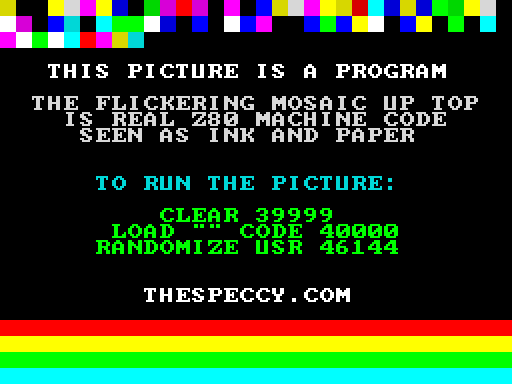
The file's picture personality — rendered directly from the
actual bytes. That mosaic across the top is the program.
Anatomy of a SCREEN$
A Spectrum screen dump is two things glued together: 6144 bytes of
bitmap (one bit per pixel, in the machine's famously interleaved
layout) followed by 768 bytes of attributes — one byte
per 8×8 character cell, controlling that cell's colours:
bit 7      FLASH
bit 6      BRIGHT
bits 5-3   PAPER colour (0-7)
bits 2-0   INK colour   (0-7)
And here is the whole trick: every possible byte value is a legal
attribute. There is no such thing as an invalid colour. Which means
the attribute area of a screen can hold absolutely anything… including
executable Z80 machine code. The display hardware will happily interpret your
opcodes as ink and paper; the CPU will happily execute your colour scheme.
One file, two load addresses
The tape header declares a load address of 16384 — the screen — so
a plain LOAD "" CODE paints the picture. But BASIC lets you
override a CODE block's address, and that gives the file its second life:
Why 46144? The code sits in the attribute area, which starts 6144 bytes into
the file: 40000 + 6144 = 46144. The bitmap — all
6144 bytes of picture data — is never executed at all.
The payload
Seventy-four bytes, hand-assembled. It leans on the ROM for all the hard work:
        ORG  46144
        LD   B,64        ; 64 border changes
outer:  LD   A,B
        AND  7           ; colour 0-7
        OUT  (254),A     ; set the border
        LD   DE,3072     ; delay counter
delay:  DEC  DE          ; DEC rr sets no flags...
        LD   A,D         ; ...hence this OR test
        OR   E
        JR   NZ,delay
        DJNZ outer
        LD   A,7
        OUT  (254),A     ; border back to white
        LD   A,2
        CALL 0x1601      ; ROM CHAN-OPEN: stream 2 (the screen)
        LD   HL,msg
print:  LD   A,(HL)
        OR   A
        RET  Z           ; zero terminator -> back to BASIC
        RST  0x10        ; ROM print routine
        INC  HL
        JR   print
msg:    DEFB 13
        DEFM "HELLO! I WAS HIDING IN THE COLOURS."
        DEFB 13, 0
Two details worth savouring:
The program flashes at you. Any opcode with bit 7 set
becomes a FLASH attribute on screen. OUT (254),A is
0xD3 0xFE — both high — so the instruction that
paints the rainbow border literally blinks in the mosaic. The code
advertises itself.
The message is readable in the colours. ASCII capitals
are 0x41-0x5A — bit 6 set, bit 7 clear — so the hidden text
appears as a run of BRIGHT, non-flashing cells. Once you know, you can
almost read it off the screen.
Try it yourself
polyglot.tap
— the tape image. Open it in
Fuse
or any emulator that accepts .tap files.
polyglot.scr
— the raw 6912 bytes, for hex-editor spelunking.
polyglot_screen.py
— the generator: dependency-free Python 3 that builds the whole
thing, hand-assembled opcodes and all. Change the message, redraw the
picture, make your own.
Picture personality: LOAD "" CODE. Program personality: the
three lines above. Same file, same bytes, both true.
Where you could take it
A loading screen for your own game that, loaded elsewhere, becomes the
game's cheat menu — the easter egg hides on the box art.
A demoscene entry where every effect's code is shown on screen
as colour while it runs.
The bitmap area is 6144 unexecuted bytes — room for a much bigger
second payload, with the attribute code as a stage-one loader that
copies it somewhere safe.
The 8×8 character font used in the picture is public domain (by Marcel
Sondaar and Daniel Hepper). Everything else — file, code and generator
— is original to The Speccy: consider it public domain too. If you build
something with it, we'd love to hear.
The chip inside your Spectrum also ran Pac-Man, half the arcades of the 1980s, the Sega Genesis's sound, and — through a direct descendant — is still inside graphing calculators being sold today. A plain-English guide to the Z80's 48-year career.
A second, independently-built take on the same premise: a bargain hunter, a security guard called Big Dave, and a legendary discount tin sealed away in Aisle 13. Same isometric-engine idea as the original, a different story, and its own fresh set of bugs a screenshot caught that the test suite alone never would have.
I set Claude Code loose on a ZX Spectrum game with $100 of credits and the new Fable model, expecting a doddle. Here's why 48K of 1982 hardware humbled it in ways a modern REST API never could.