Indo Speccy
A £10 "untested" rubber-keyed Speccy bought sight unseen in East Java, a government import ban standing between me and a bag of axial capacitors, and a £36 chip for a £10 computer.
Every ZX Spectrum ever made has one chip doing the actual thinking: a Zilog Z80. That's true of a lot more than just the Spectrum. Between its launch in 1976 and its retirement in 2024, the Z80 ended up inside home computers, games consoles, arcade cabinets, synthesizers and calculators, on every continent, for basically the whole of its 48-year working life. This is the story of that one chip, in plain English — no electronics background required.
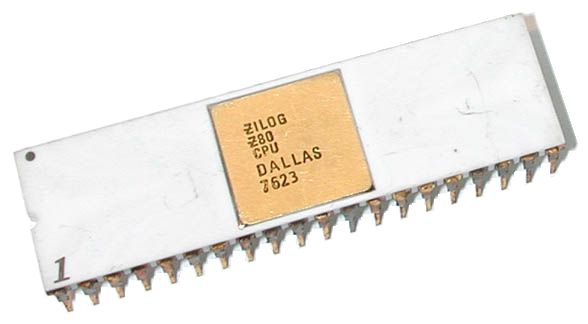
Skip this bit if you already know — but if "CPU" is just a word you've heard: a CPU (central processing unit) is the part of a computer that actually carries out instructions. Every button press, every calculation, every pixel that changes on screen ultimately runs through it, one small step at a time, thousands or millions of times a second. It's the part that makes a computer a computer, rather than just a box of memory and wires. The Z80 is one specific, famous design for that part.
The Z80 was released in July 1976 by Zilog, a company founded the year before by two engineers, Federico Faggin and Ralph Ungermann, who had previously worked on Intel's own early processors. Zilog designed the Z80 to run the same software as Intel's existing 8080 chip, while fixing several of its practical annoyances: the 8080 needed three different power supplies to work, while the Z80 needed only one, and the 8080 needed extra support chips that the Z80 built in for free. For anyone building a computer around it, that made the Z80 simpler, cheaper, and easier to design with — which mattered enormously to the small computer manufacturers of the late 1970s and early 1980s.
The honest answer is: almost everywhere. A very incomplete list of machines built around a Z80:
Nobody planned for one chip to end up in a British bedroom computer, a Japanese synthesizer, and an American calculator all at once. It happened because the Z80 was cheap, well documented, and did its job reliably — so once a generation of engineers learned how to design around it, there was very little reason to switch to something else.
That "very little reason to switch" held for a genuinely long time. Zilog kept making the original Z80 in essentially its classic form for 48 years, until its wafer foundry — the specialist factory that actually manufactures the silicon — told Zilog it was retiring support for the old manufacturing process the Z80 had always been built on. Zilog issued an end-of-life notice on 15 April 2024, and stopped taking final ("last time buy") orders for the classic standalone Z80 chip family on 14 June 2024. After 48 years, that was that — for the original chip.
The 2024 discontinuation only covered the classic standalone Z80 chip. Zilog's modern descendant of it, the eZ80 — a more integrated chip that still runs the original Z80's instructions — was not discontinued, and is still in production today. Anyone who has picked up a Texas Instruments TI-84 Plus CE graphing calculator in a school maths class in the last several years has, without knowing it, been carrying a direct descendant of the same chip family that ran the Spectrum, the Sega Genesis's sound, and the original Pac-Man cabinet. Very few 1970s chip designs can say their direct family line is still being sold new, in a mainstream product, decades after the original retired.
A £10 "untested" rubber-keyed Speccy bought sight unseen in East Java, a government import ban standing between me and a bag of axial capacitors, and a £36 chip for a £10 computer.
That smudgy, wrong-colour halo around old Spectrum sprites has a name, and a very simple cause: the machine can't remember a separate colour for every pixel. A tiny program below proves it, live, on screen.
A second, independently-built take on the same premise: a bargain hunter, a security guard called Big Dave, and a legendary discount tin sealed away in Aisle 13. Same isometric-engine idea as the original, a different story, and its own fresh set of bugs a screenshot caught that the test suite alone never would have.