I have been living in Indonesia for ten years now. About three years ago, I
saw a post on Facebook about the ZX Spectrum and promptly joined the group to
satisfy a nostalgia hunger I didn’t even know I had.
I then watched the excellent BBC drama Micro Men, which dramatises
the rivalry between Sir Clive Sinclair and Chris Curry. More details here:
https://en.wikipedia.org/wiki/Micro_Men
This was a mistake.
After feasting on nostalgia, I really wanted to play Jetpac and
Manic Miner again. Not on an emulator, though. I wanted to play them
on a real ZX Spectrum.
I checked the local online marketplace, Tokopedia, but could only find a ZX
Spectrum Vega, which is essentially a modern plug-and-play console. That
wasn’t what I wanted. I wanted the real thing: rubber keys, horrible
joystick controls and all.
A few weeks passed and I took another look.
To my surprise, an old rubber-keyed wonder was listed for sale in East Java.
It was advertised as “untested”.
Now, I have bought enough second-hand electronics to know that
“untested” can mean one of two things:
Nobody has actually tested it.
We have tested it, it doesn’t work, but we cannot officially
advertise it as “broken” because that would mean admitting we
are selling broken electronics.
It was listed for 200,000 IDR, about £10.
It was the unit only. No power supply, no cables, no box, no manual, no
accessories. Just the rubber-keyed block.
Obviously, I bought it.
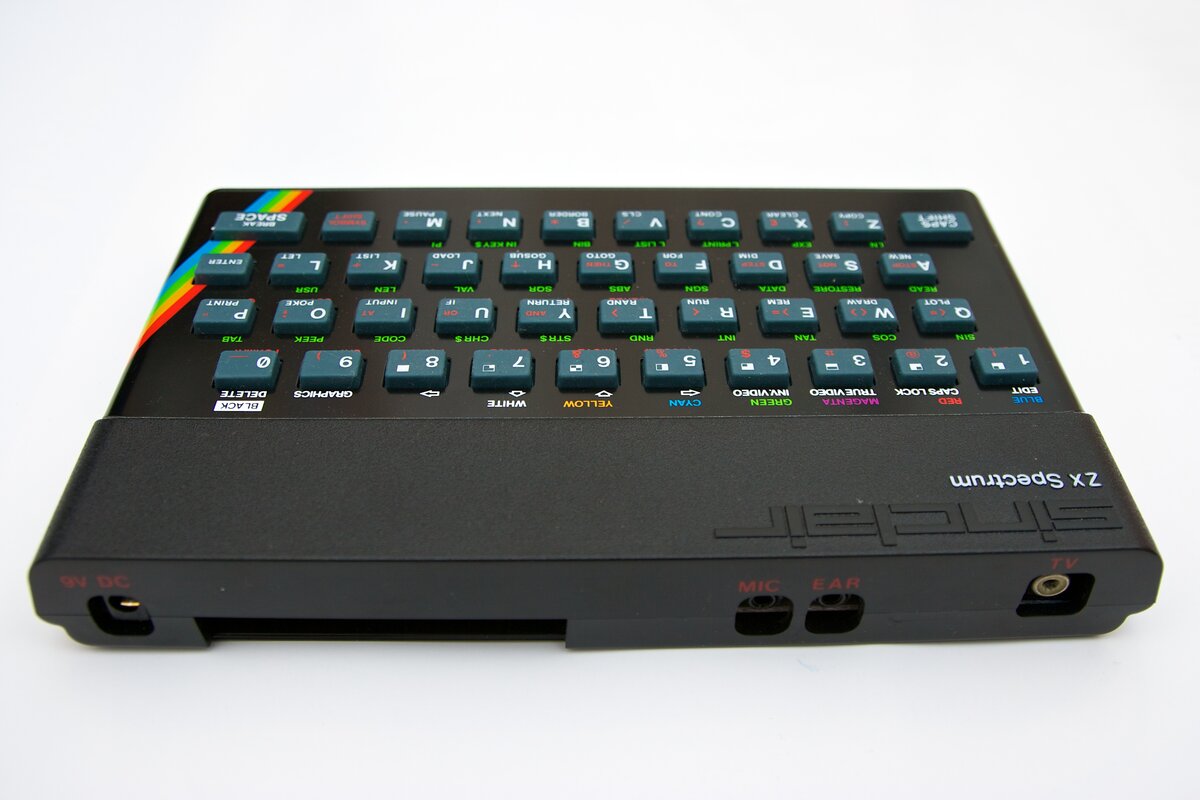
A rubber-keyed 48K Speccy, same model as the one that turned up in
East Java — not the actual unit, but exactly what £10 of
“untested” looks like. (Nico Kaiser, Wikimedia Commons, CC BY 2.0)
When it arrived, I was as excited as Christmas Day 1984.
There was just one small problem.
I didn’t have an old TV with an analogue RF input.
I used Google to see how other people were connecting their old Speccys to
modern flatscreen HD televisions. I discovered something called the
“Comp Mod”, which allows you to get a more usable video signal
from the Spectrum.
I headed over to YouTube and found a huge selection of videos showing how to
perform the modification. Whilst I was there, I also found a frightening
number of videos about repairing old Speccys.
It was a very good job I watched them.
I could have done a lot of damage if I had simply plugged it in.
The Spectrum has an unusual power connector arrangement, with the centre pin
being negative and the outer barrel positive. This is the exact opposite of
what you would expect from a modern power supply. If I had connected a
regular 12V adapter, I could have caused some serious damage.
The original power circuitry also contains a 7805 voltage regulator which is
notorious for generating a considerable amount of heat. After more than forty
years, I wasn’t particularly keen on subjecting my newly acquired
treasure to any more heat than absolutely necessary.
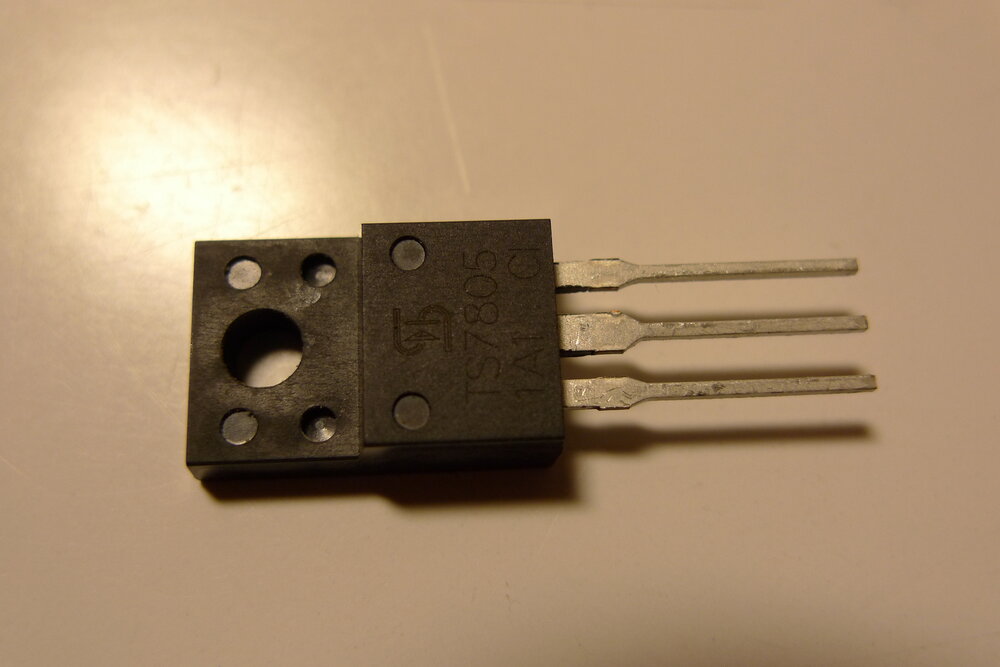
A 7805-family linear regulator, same family as the one on the
Spectrum’s own power board — small, cheap, and generates a
surprising amount of heat for its size. (Anonimski, Wikimedia Commons, CC0)
I also discovered that the electrolytic capacitors on the motherboard are now
getting rather old. Some people recommend replacing them as part of a
refurbishment, particularly on a machine that has spent more than four
decades sitting around waiting for somebody like me to come along.
My Speccy was over 40 years old.
I think it had earned some new capacitors.
The Speccy used axial capacitors, which were quite normal for the period,
whereas Tokopedia only stocked radial capacitors. Electrically, they are
effectively the same thing; the difference is that the wires come out of
opposite ends of an axial capacitor and from the same end of a radial one.
I could have made the radial capacitors work, but it would have been
unsightly and, frankly, a bit of a bodge.
I looked on AliExpress and was delighted to see that they stocked the axial
capacitors.
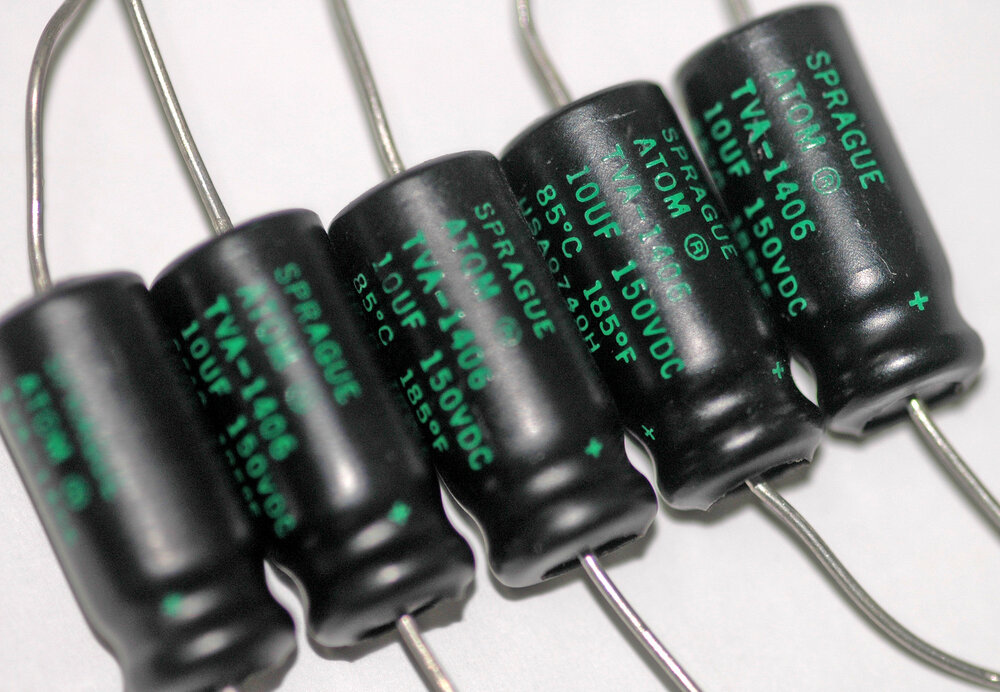
Axial electrolytic capacitors — leads out of both ends,
same style used throughout an original Spectrum board.
(Mataresephotos, Wikimedia Commons, CC BY 3.0)
However...
The Indonesian government had recently banned imports from AliExpress.
If I wanted those axial capacitors, I was going to have to be patient.
It turned out that I needed a replacement voltage regulator, a new transistor
(TR3), and I had also identified some potential issues with the RAM chips.
This £10 bargain was becoming very expensive indeed.
The voltage regulator itself was quite common and easy to buy, even in
Indonesia.
But there is always a but.
The original regulator generates an awful lot of heat. It has a massive
heatsink attached to it and is probably one of the reasons heat-related
damage is such a concern with these old machines.
There are modern switching voltage regulators that generate almost no heat at
all and would certainly help prolong the life of the Speccy once refurbished.
The downside is that you are moving away from the original specification.
The unit was now 45 years old.
I wanted my son to inherit it one day and not have to worry about replacing
parts, so I opted for the modern switching regulator.
Unfortunately, like the capacitors, it wasn’t available in Indonesia.
The RAM chips were, well, cheap as chips.
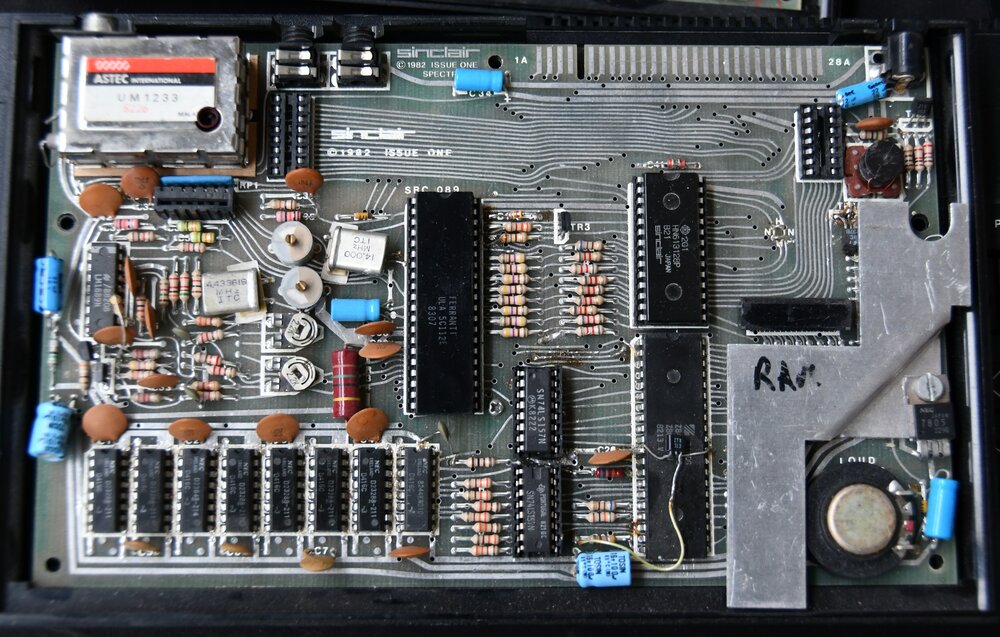
A real Issue One board — the RAM chips in their sockets
along the front edge are the kind mine needed replacing, and the black
FERRANTI ULA 5C1 chip just left of centre is the one that
turns up again later in this story. (Fernando Sáenz Perez,
Wikimedia Commons, public domain)
I contacted several vendors on Tokopedia who had advertised the chips.
However, they told me they couldn’t honour the advertised price and
that there was a two-month lead time.
The revised price was extortionate.
I figured they wanted to charge me for the airfare to visit a distant
relative who lived in a territory that AliExpress actually did ship
to.
As luck would have it, my sister was visiting me from the UK during Easter
that year, so I placed all my orders with AliExpress and a local component
store in Birmingham.
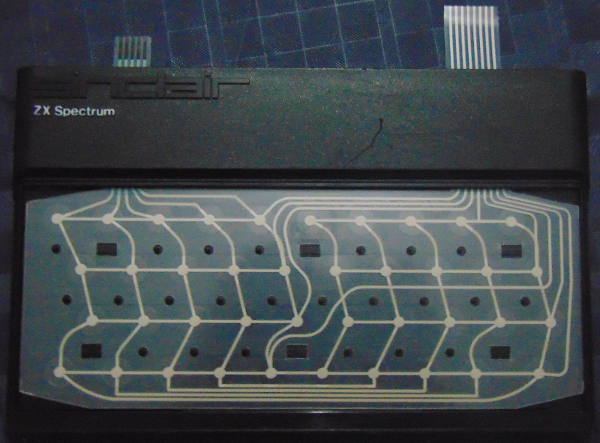
I also had to order a replacement keyboard membrane. The old one
disintegrated almost as soon as I opened the Speccy up.
A ZX Spectrum 48K membrane keyboard — the printed circuit
that sits under the rubber keys, and exactly the kind of thing that
disintegrates after forty-odd years. (Alejandro Sánchez,
Wikimedia Commons, CC BY-SA 4.0)
Easter came.
I got my spare parts.
I got to work.
I really had no idea how much I hated desoldering, especially the old RAM
chips. There is something particularly satisfying about finally removing a
component that has been soldered into a circuit board since the early 1980s.
There is also something particularly satisfying about never having to
desolder it again.
Eventually, all the faulty parts had been replaced.
I performed the Comp Mod to bypass the RF video output, and I was finally
ready to power her on.
The text was slightly ghosting a few lines down the screen.
So close.
But not quite there.
More Googling followed.
I worked out that one of the most important chips in the entire machine, the
ULA, was probably the culprit.
The ULA is a custom chip designed specifically for the ZX Spectrum and
performs a huge amount of the machine’s work. Unfortunately, the
original manufacturing process disappeared decades ago, so finding an
original replacement is becoming increasingly difficult.
Fortunately, modern reverse-engineered replacement ULAs are now available.
I found one advertised for around £36.
£36 for a chip.
For a computer that had cost me £10.
At this point, I had crossed the line between “repairing an old
computer” and “financially rescuing a member of the family”.
The replacement ULAs are essentially modern recreations of the original
functionality, produced in relatively small quantities. I found a seller in
the UK and placed an order.
A friend was coming to visit in the autumn and kindly brought it over with
him.
The moment of truth arrived.
I plugged in the new ULA.
The ghosting was gone.
I loaded Jetpac.
And suddenly, it was Christmas 1984 again.
Only this time, I was playing it in Indonesia, on a 45-year-old computer that
had cost me £10, crossed half a world, survived an assortment of
replacement components, a government import ban, several hundred solder
joints and a £36 modern recreation of a chip that hasn’t been
manufactured for decades.
Was it worth it?
Absolutely.
Would it have been cheaper to buy a working Spectrum?
The chip inside your Spectrum also ran Pac-Man, half the arcades of the 1980s, the Sega Genesis's sound, and — through a direct descendant — is still inside graphing calculators being sold today. A plain-English guide to the Z80's 48-year career.
That smudgy, wrong-colour halo around old Spectrum sprites has a name, and a very simple cause: the machine can't remember a separate colour for every pixel. A tiny program below proves it, live, on screen.
My brother typed in a Hello World loop from the orange Sinclair manual. I changed one line, hit RUN, and turned around for an audience that wasn't there.