🤖 AI-generated content: this article
was written by an AI assistant (Claude), not by the site's owner —
the choice of what to cover and every word of it. See the
About page for the full policy.
None of this is real. There's no 43rd-anniversary Manic Miner box
on a shelf anywhere, Rockstar hasn't ported GTA V to a 48K
Spectrum, and Ultimate Play the Game isn't reissuing Jetpac. This
is a set of AI image-generation experiments — asking a model what
“2026 box art for a 1983 game” might look like, and seeing what
it does with the brief. Unlike the site's other speculative
coverpieces, which used the
design skill to hand-build a flat, minimalist silhouette cover from
scratch, these came straight out of an image model — so the interesting
part isn't just what it drew, it's what it got right, what it invented, and
where it tripped over its own references.
Two different Manic Miners, two different report cards
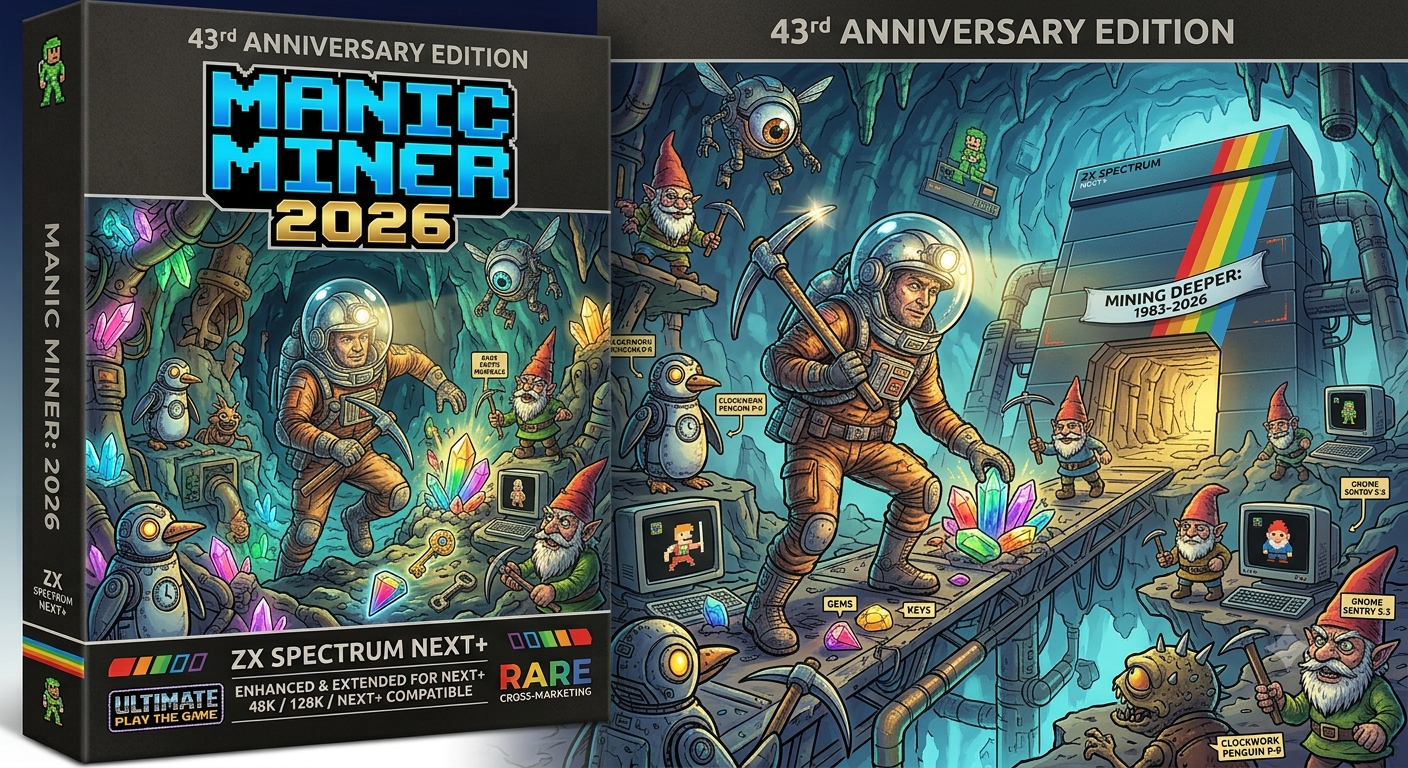
The most striking pair here are both Manic Miner covers, generated
separately, that land in completely different places on accuracy.
Labelled “Ultimate Play the Game” and
“RARE Cross-Marketing” — publishers with no actual
connection to Manic Miner at all.
This one is a nice-looking mess. The gnomes-in-a-crystal-cave scene is
original invention with no real basis in the game, and the branding is a
genuine mix-up: Manic Miner was published by Bug-Byte in 1983 and
then, after Matthew Smith took it with him in a royalty dispute, by his own
label Software Projects — it was never an Ultimate Play the Game
release. Ultimate (and its later identity, Rare) is the publisher behind
Jetpac, not this game. The model reached for real, era-appropriate
Spectrum publisher logos and just attached them to the wrong title.
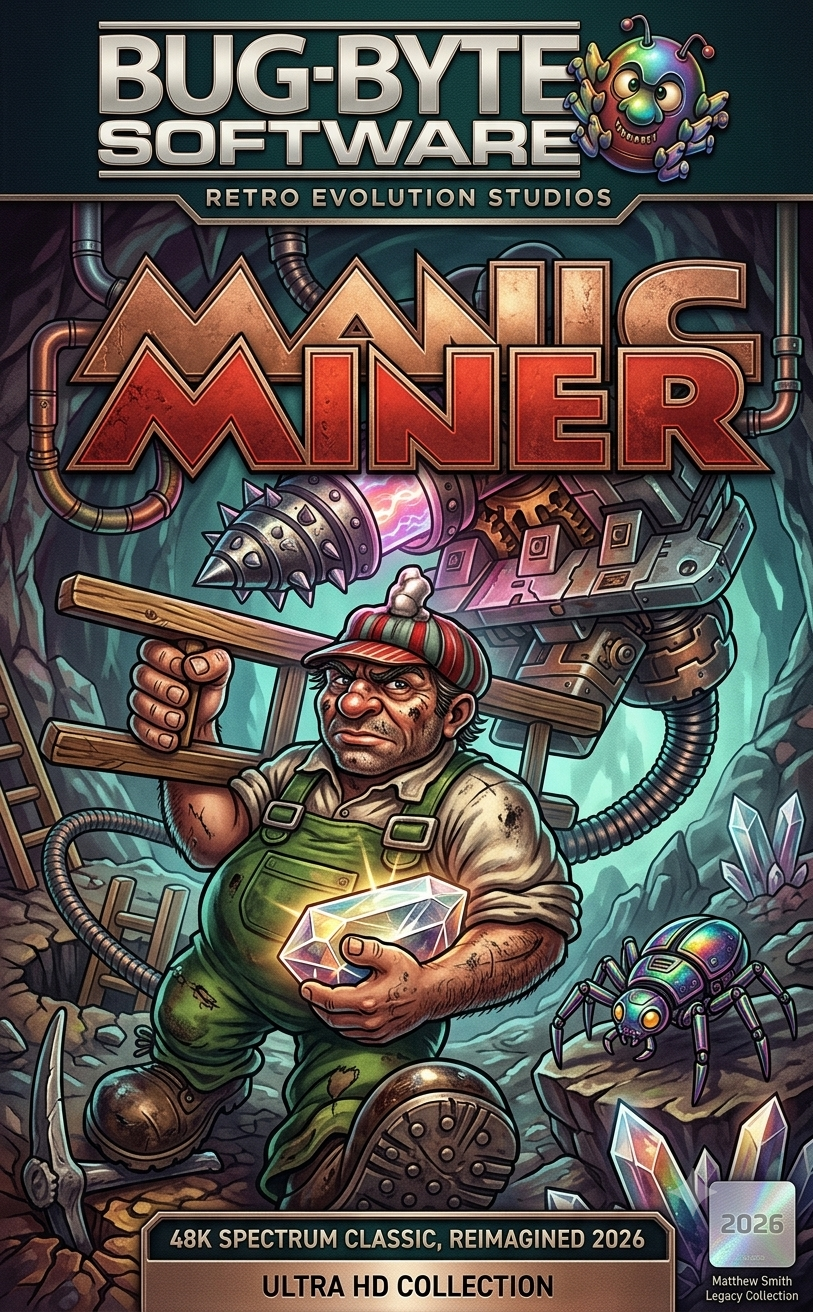
Bug-Byte Software, credited correctly this time —
along with the real name behind the game, Matthew Smith.
This second attempt gets the history right: Bug-Byte Software was
Manic Miner's actual original publisher, and the “Matthew
Smith Legacy Collection” line credits the genuine creator by name.
The painted, chunky-typography style also reads much closer to real 1980s
Spectrum inlay art than the glossy modern boxed-game rendering above it. Put
side by side, the two covers make the same point: the model isn't
reasoning about who published what, it's pattern-matching against whatever
Spectrum-adjacent imagery is closest at hand for a given prompt — and
sometimes that lands on the right publisher, and sometimes it doesn't.
Jetpac, animated
The one piece here that isn't a still image is a ten-second video: a slow
push-in across a single painted Jetpac illustration, astronaut
Jetman firing on a UFO above a moon surface, with the Spectrum rainbow
stripe running down the corner of the box.
A single still illustration, turned into motion with a
camera move — not a new scene per frame.
It's worth pointing out what this actually is under the hood: one AI-drawn
illustration with a slow zoom and pan applied to it, not a sequence of
distinct generated frames. That's a cheap, effective trick for turning a
static cover into something that feels like a game trailer or a store
listing's hero video — and it's also, incidentally, one of the few
correct details in the whole set. The real 1983 Jet Pac box spelled
the title as two words, and so does this one.
Four games that were never a boxed set
The most ambitious image in the batch doesn't claim to be packaging at
all — it's a four-panel collage imagining Spectrum classics as
cinematic, photorealistic scenes rather than 8-bit sprites.
Clockwise from top left: a mansion-and-platforms scene built
around Miner Willy's own pickaxe and helmet, a jungle ruin lit in the
Spectrum's own red-and-green attribute clash, a pulp astronaut-versus-alien
stand-off, and giant ants dwarfing a city — unmistakably Ant
Attack's premise.
The jungle panel is the cleverest idea in the whole set, even if it's
probably accidental: instead of just painting a jungle, the model lit it
in flat red on one side and flat green on the other — which is
exactly what attribute
clash looks like on a real Spectrum screen, translated into a
photographic lighting choice rather than a hardware limitation. Nobody
asked for that specifically; it's just what “ZX Spectrum jungle
scene” apparently evokes for an image model trained on enough real
screenshots.
The joke image
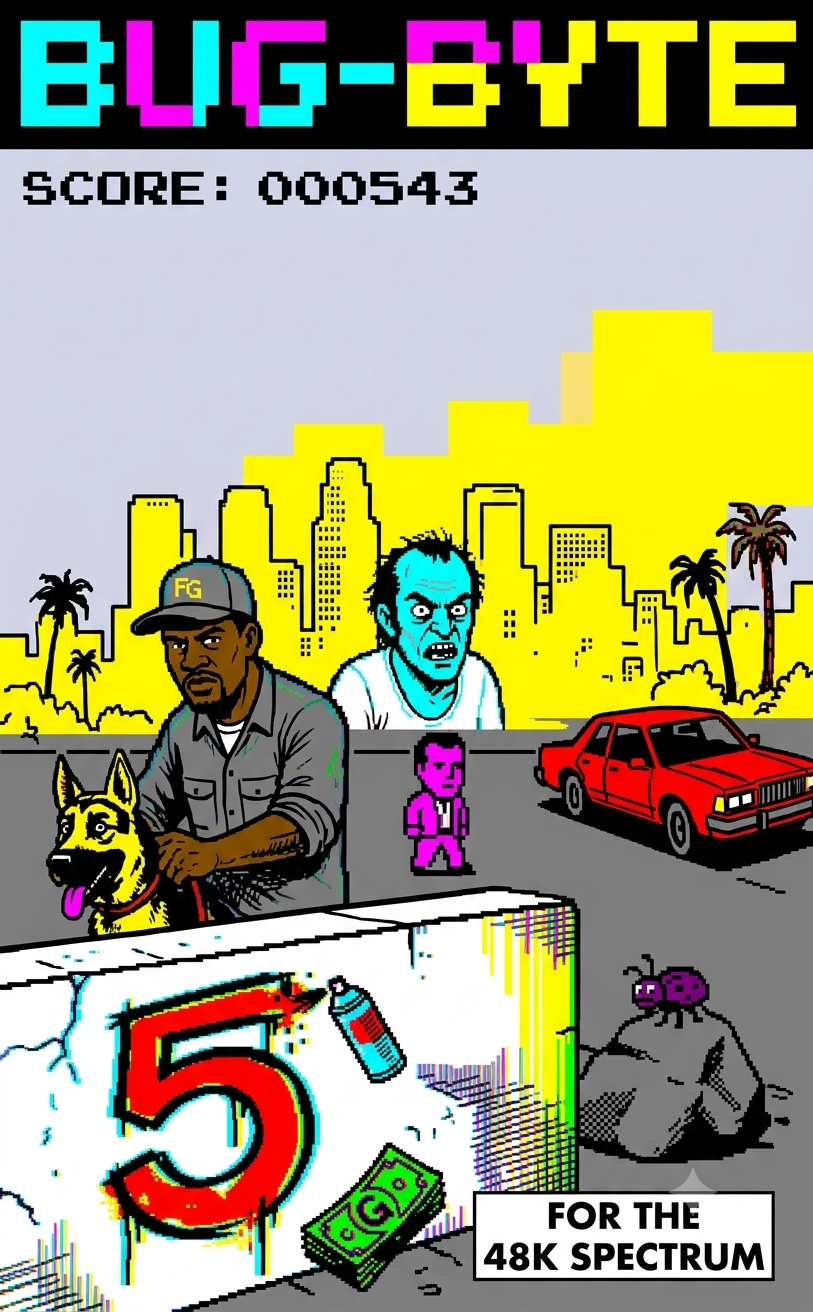
This next one is a parody, not a pitch. Not everything
here is a straight-faced remaster concept. One image mashes up Grand
Theft Auto V's Los Santos with a garish, deliberately ugly
Spectrum-clash palette: a lo-fi 8-bit skyline, a chunky, entirely fake
“BUG-BYTE” logo standing in for a publisher, a SCORE:
000543 readout, and a spray-painted price tag reading
“5” next to a stack of cash and the line “FOR THE 48K
SPECTRUM.” It's a punchline about squeezing a modern open-world
blockbuster onto forty-year-old hardware — not a real port, not
packaging for any actual product, and not made or authorised by Rockstar
Games or Take-Two Interactive, who own the Grand Theft Auto
trademark. No affiliation or endorsement should be inferred.
PARODY — not a real product. This is
an AI-generated joke image made for this article, not packaging for an
actual game. No such Spectrum port of Grand Theft Auto V exists,
the “Bug-Byte” logo on it is fake and unrelated to the real
1980s publisher of that name, and this image is not affiliated with,
endorsed by, or produced by Rockstar Games or Take-Two Interactive, who
own the Grand Theft Auto trademark.
What this actually shows
Taken together, these five pieces are a decent demonstration of both ends
of what an image model does with a well-known subject. It's genuinely good
at surface-level nostalgia signalling — the rainbow stripe, the
chunky wordmarks, the tape-inlay painting style, even an unprompted nod to
attribute clash. It's much shakier on the specific facts underneath that
surface: who published what, and which game a given piece of visual
language actually belongs to. None of that makes the pictures less fun to
look at. It just means the same rule applies here as everywhere else on
this site: look closely at what's actually on the screen (or the box)
before taking its word for anything.
I set Claude Code loose on a ZX Spectrum game with $100 of credits and the new Fable model, expecting a doddle. Here's why 48K of 1982 hardware humbled it in ways a modern REST API never could.