Make and Program Your Own Robots
A slim, cheerful 1985 paperback that pairs BASIC listings with actual Meccano-and-motor robot builds, written around the Datel Robotek interface this site has its own recreated PCB for.
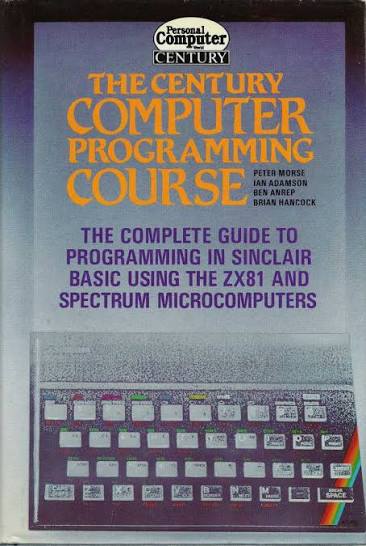
The Century Computer Programming Course — full title The Complete Guide to Programming in Sinclair BASIC Using the ZX81 and Spectrum Microcomputers — is a book that was clearly aimed above the usual pocket-money price point of Spectrum literature. It shipped as a hardback (ISBN 0-7126-0072-8, with a paperback edition at 0-7126-0073-6) for £9.95 in 1983, when the Spectrum itself could be had new for not much more than three times that. That's a serious ask for a programming manual, and it tells you something about who Century Publishing thought was buying it: not a kid with a Christmas-present Spectrum, but a household that already owned a ZX81 and had just added, or was about to add, a Spectrum alongside it.
That dual focus is the book's defining feature. Rather than picking one machine and teaching Sinclair BASIC through it, it covers the ZX81 and the Spectrum together — a genuinely useful angle for 1983, when plenty of families had upgraded rather than replaced, and the differences between the two dialects of Sinclair BASIC (the ZX81's integer-only arithmetic and single-line command entry versus the Spectrum's floating point, colour, and sound) were exactly the kind of thing that could trip up someone moving from one machine to the other.
A course book like this lives or dies by whether the listings actually work
when you type them in, so it's worth showing one running rather than just
describing the theory chapters. Buried among the exercises is a short reflex
game: catch a falling ball with a bat you steer along the bottom of the
screen using the 5 and 8 keys, twelve balls per go. The program's own
REM header calls it "BUG", but the message it
actually prints on a miss is SPLAT — the book never
explains the mismatch, and the listing itself is the only surviving
record of what it was meant to be called.
![Scanned BASIC listing for the Splat game from The Century Computer Programming Course, lines 5 to 220, with bracketed editorial notes in the margin calling out exact spacing such as [2 Spaces,*] and [3 SP,<=>,3 SP]](/assets/img/SplatCode.png)
PRINT AT positioning is unforgiving of a miscounted space, so
the book spells out exactly how many blanks belong in each string rather
than trusting the reader to count them off the page.
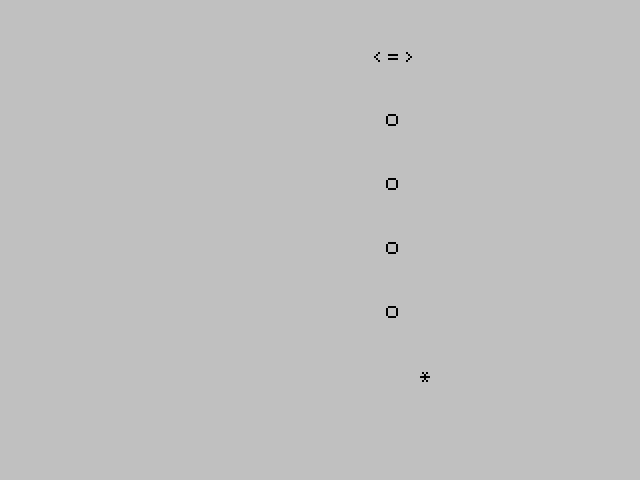
Typed in and run, it's a perfectly serviceable five-minute diversion: the
bat (<=>) waits at the bottom while a ball
(O) fine-tunes its horizontal position mid-fall thanks to a bit
of one-line arithmetic at line 90 that only sometimes nudges its column,
so no two drops behave quite the same.
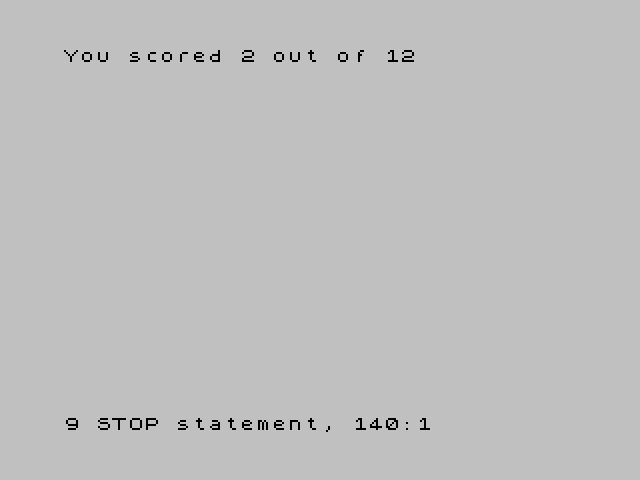
Miss enough of them (or just give up and press 6, the listing's own quit
key at line 70) and the score prints, followed by
9 STOP statement, 140:1 at the bottom of the screen. That's not
a crash: it's Sinclair BASIC's completely ordinary way of announcing that
line 140's STOP command — the listing's actual, intended
ending — has been reached. Type-ins of this era routinely ended this
way rather than with a tidy menu, which is exactly the kind of unglossed
detail that separates an original scan of the exercises from a modern
paraphrase of them.
It was reviewed contemporaneously in both Sinclair User (July 1983) and Your Spectrum (January 1984), which at least confirms it registered as a real contender in a crowded field of Spectrum programming books rather than sinking without trace. Whether the hardback price bought genuinely better material than the cheaper paperback guides on the same shelf is the harder question — but the premise, a single course spanning both Sinclair machines rather than starting from scratch on each, was a solid one for the audience it was clearly built for.
Nothing is hosted on this site — the links go to the external sites credited above. See the Downloads page for more archives and emulators.
A slim, cheerful 1985 paperback that pairs BASIC listings with actual Meccano-and-motor robot builds, written around the Datel Robotek interface this site has its own recreated PCB for.
A 52-issue weekly partwork that built into a 1,600-page programming course spanning six machines at once, including the Spectrum — and buried inside it, a 22-part machine code epic almost nobody finished typing in.