The Century Computer Programming Course
A hardback programming manual at £9.95 — nearly a third of a Spectrum's own price — that covers the ZX81 and the Spectrum side by side rather than picking one.
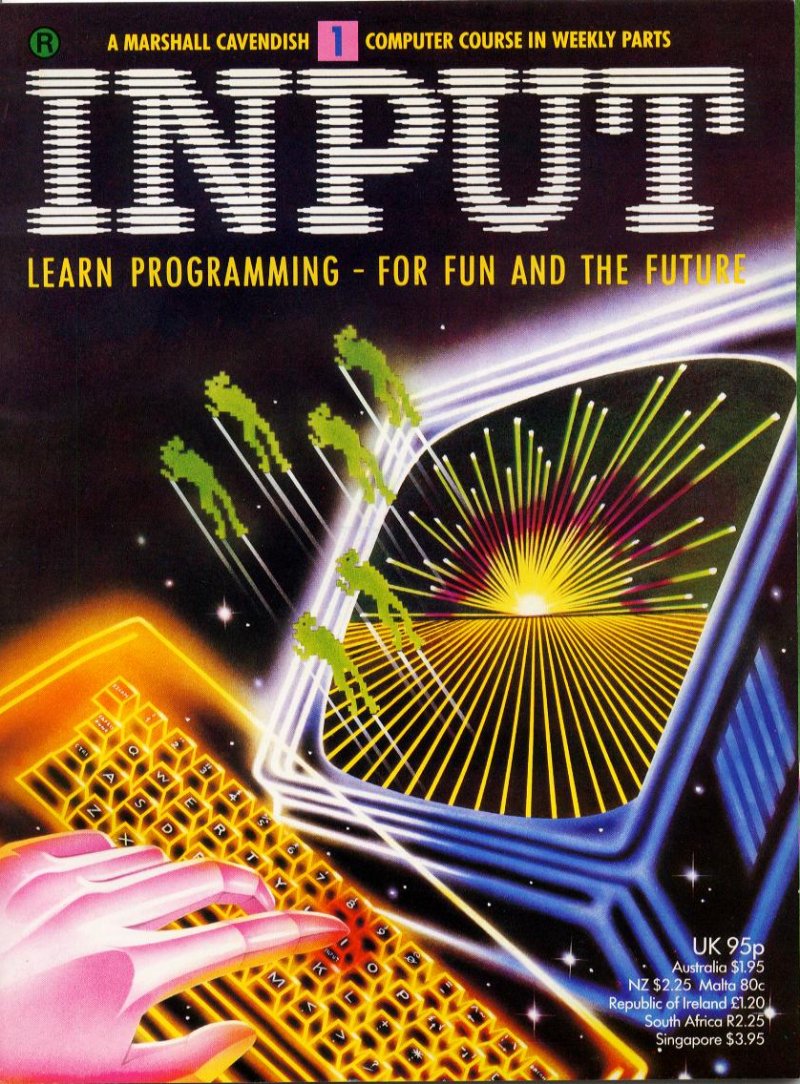
Input wasn't a magazine you subscribed to so much as a magazine you committed to. Marshall Cavendish sold it as a newsagent partwork — 95p an issue at the start, out every week for a year, designed from day one to be hole-punched and filed into four ring binders you bought separately. Fifty-two issues later you owned something closer to an encyclopedia than a magazine: roughly 1,600 pages split across six running strands (92 BASIC lessons, 54 on machine code, 55 games programming instalments, 38 on applications, 19 on peripherals, 11 on languages), all serialised in parallel so that no single issue was ever "just" one topic.
The ambition that made Input distinctive was also its oddest feature on a Spectrum-focused shelf: it wasn't written for the Spectrum. Every lesson was pitched simultaneously at the ZX Spectrum, Commodore 64, BBC Micro/Electron, and Dragon 32, with a fair few listings also adapted down for the ZX81 and VIC-20. A BASIC concept would be taught once in prose, then given five parallel code listings, one per machine, printed side by side. For a Spectrum owner that meant wading past four other dialects of BASIC to find the column meant for you — slower than a Spectrum-only book, but it also meant the explanations underneath the code had to be pitched at the actual language concept rather than one machine's syntax quirks, which reads better today than most of its single-platform contemporaries.
Buried inside the games-programming strand was Cliffhanger, a full machine code arcade game — a figure scrambling up a shoreline, leaping snake-filled holes and rocks bouncing down the hillside — serialised in Input across 22 separate parts starting in issue 29 (volume 3, March 1984). Typing in a few pages of BASIC over a weekend is one thing; typing in a machine code listing in weekly instalments across most of half a year, saving and re-loading a growing program on cassette between sessions with no way to check a part-finished listing actually ran, is another. By every account from readers who lived through it, vanishingly few people had a working, complete Cliffhanger to show for it — which makes it less a game you played and more a stress test of how much monthly commitment a partwork could ask of a reader before the format itself became the obstacle.
Judged as a programming course, Input earns its reputation: contemporary and modern readers alike single out the listings as unusually clean and well-explained, and the multi-machine format means the BASIC lessons age into something closer to a real introduction to the language than a transcription exercise. Judged as a Spectrum purchase specifically, it's a harder sell — the weekly cover price crept up over the run and the binders were sold on top of it, so a complete four-volume set cost noticeably more than any single Spectrum programming book on the same shelf, for a course that spent four-fifths of its page count on machines you didn't own. It's a fascinating artefact of how ambitious partwork publishing got in 1984, and a genuinely good way to learn to program — just not the most efficient way to learn to program a Spectrum.
Nothing is hosted on this site — the links go to the external sites credited above. See the Downloads page for more archives and emulators.
A hardback programming manual at £9.95 — nearly a third of a Spectrum's own price — that covers the ZX81 and the Spectrum side by side rather than picking one.
A slim, cheerful 1985 paperback that pairs BASIC listings with actual Meccano-and-motor robot builds, written around the Datel Robotek interface this site has its own recreated PCB for.