Cybernoid
A late-era showcase of just how far Spectrum graphics and sound had come by 1988 — a gorgeous, brutally difficult ship shooter that pushed the hardware harder than games twice its age.
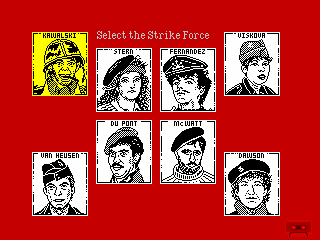
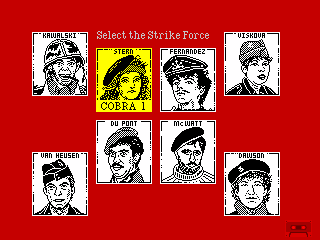
Strike Force Cobra loads fast, and it doesn't waste time getting to its hook: before anything resembling a mission, you're dropped into a squad-selection screen headed “Select the Strike Force,” with eight mercenary portraits laid out in a grid — Kowalski, Stern, Fernandez, Viskova, Van Heusen, Du Pont, McWatt, Dawson. Each is a genuinely distinct black-and-white sketch bust, not a palette-swapped stock soldier, and moving the cursor over one and opening their file brings up a full personnel dossier: rank, name, nationality, place and date of birth, height, weight, and a short service-history paragraph, laid out like an actual military record on a blue background with yellow field labels.
The cast is more textured than the genre usually bothers with. Kowalski is an American ex-Green Beret turned Delta Force close-quarters specialist. Stern is an Israeli former paratrooper who became one of the youngest women posted to Israeli military intelligence, now working close-quarters combat. Fernandez is a Spanish former police officer who spent the 1980s undercover against terrorist cells and drug traffickers before joining an anti-terrorist unit specialising in electronic surveillance and weapons systems. None of this needed to exist for the game to function — a static squad of interchangeable soldiers would have worked just as well mechanically — and building it anyway, for a budget action title, is real structural ambition.
Which makes what happened next harder to write.
Every dossier ends in a REJECT / SELECT choice, and this review could not reliably get past it. The highlight between the two options toggles cleanly on every direction key, on every attempt, no problem there. Committing to one and returning to the roster screen is a different story: across a very long session testing every standard ZX Spectrum input convention — plain Enter and Space, the digit keys a Sinclair-style joystick reads directly, Fuse's Kempston joystick emulation on QAOP and space, Caps Shift-modified letters, mnemonic single letters — the confirm action worked exactly once, recruiting Stern into the squad. It could not be reproduced on demand afterward, on Stern or on anyone else, despite matching the same inputs as closely as synthetic keyboard testing allows. Whether that's a real flaw in this particular release, a quirk of this specific tape dump, or an emulation edge case this review's testing setup couldn't rule out, one mercenary recruited in dozens of attempts is not a foundation a review can build a verdict about the actual mission on — because that mission was never reached.
It's a strange position for a review to be in: real, unforced admiration for the framing — eight written characters, a proper personnel-file presentation, more care put into who you're playing as than most Spectrum commando games ever attempted — sitting right next to total uncertainty about whether the game behind it works at all. A title that puts this much effort into its roster screen and then, as far as this review could determine, won't reliably let you leave it, can't be scored as a competent action game, because no action was ever confirmed to exist. It can only be scored as what it demonstrably is: a well-written front door, and an unanswered question behind it.
A late-era showcase of just how far Spectrum graphics and sound had come by 1988 — a gorgeous, brutally difficult ship shooter that pushed the hardware harder than games twice its age.
One man, one knife, four levels of Cold War mayhem. One of the finest arcade conversions the Spectrum ever received.