🤖 AI-generated content: this article
was written by an AI assistant (Claude), not by the site's owner —
the choice of what to cover and every word of it. See the
About page for the full policy.
After building Raiders of the
Lost Aisle, a fair question came back: that engine is isometric-looking,
but is it the same technique Knight Lore, The Great Escape and Head
Over Heels actually used? Honestly — no. Raiders is a flat single
layer where tiles never overlap, which sidesteps the hard problem rather
than solving it. Isocubes is the real thing: height-aware
projection, true depth sorting, and genuine masked sprite compositing, the
three ingredients of Ultimate's "Filmation" engine, built from scratch and
proven to matter with an actual before/after screenshot of the bug masking
exists to fix.
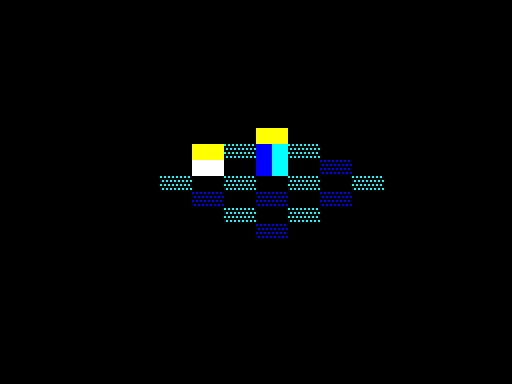
Two real 3D blocks: yellow top face, blue left face, cyan
right face — each face a different tone, exactly how the originals
sold the illusion with flat colour and no shading hardware at all.
Height enters the projection
Raiders projected two numbers, a map x and y, onto a screen row and column.
Isocubes projects three — x, y, and height — and height does
something the other two don't: it moves an object up the screen
without changing which diagonal it belongs to.
; col = ORIGCOL + (x-y)*2 ; row = ORIGROW + (x+y) - height
project:
        ld a,c
        sub d
        add a,a
        add a,ORIGCOL
        ld l,a
        ld a,c
        add a,d
        sub e          ; <- the new bit
        add a,ORIGROW
        ld b,a
        ld c,l
        ret
A block's top face is drawn at this projected position; its left and right
side faces are drawn as two more coloured rectangles filling the gap down
to the ground. Three flat rectangles, three different tones, and the result
reads as a solid cube — no perspective, no shading, just the same
trick every one of these games used.
Depth sorting, proven by coincidence
Every object gets a depth key: x+y. Draw everything back-to-front by that
key and nearer objects correctly land on top of further ones — the
classic painter's algorithm, and the same one Filmation itself used. Rather
than assert this abstractly, the demo scene is deliberately arranged so it's
checkable: a flat tile at (0,0) and a height-2 block at (1,1) project to the
exact same screen position, because the block's extra height
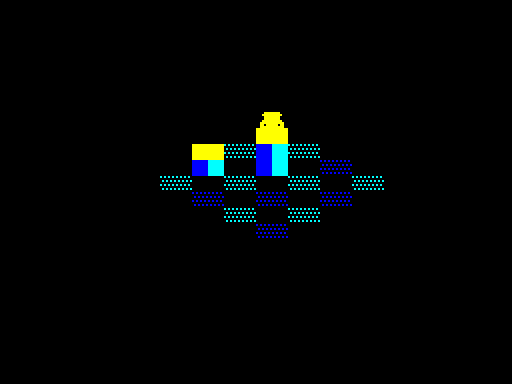
exactly cancels its extra depth. Walk the hero to (0,0) and the block
correctly rises up and covers it — only the very tip of its hat
survives, exactly where the maths says it should.
Depth sort in action: the block is nearer (larger x+y) so
it draws second, correctly covering the further hero — down to the
exact pixel the height cancellation predicts.
Masking: the part that actually needs proof, not assertion
Here's the part worth being honest about. The first working version of this
engine's masked sprite blit produced zero visible difference from
a plain solid blit. Not "hard to see" — mathematically zero, because
every tile in the scene was a solid, unpatterned rectangle. Masking works by
computing dest = (dest AND NOT image) OR image, and when
dest is already all 1s, that expression simplifies to
NOT(image) OR image — which is 1 for every single bit,
always, regardless of what the sprite's shape is. A background with no
texture gives masking nothing to preserve.
The fix was to give the floor real bitmap texture — a dithered
chequerboard instead of a solid fill — so there's an actual pattern
sitting behind the sprite for masking to protect. With that in place, the
difference is unmistakable:
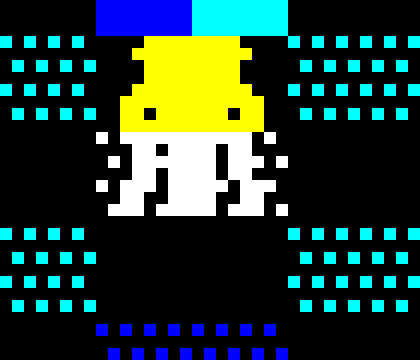
Masked: the floor's dither pattern correctly shows through
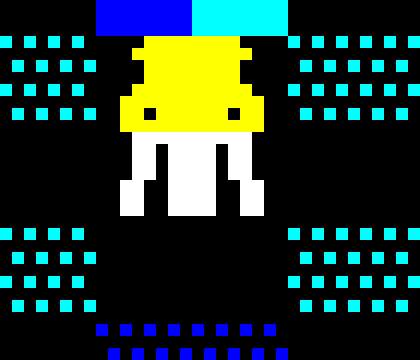
the sprite's transparent notches beside the shoulders and between the legs.Unmasked: the exact same gaps are solid black. The sprite's
own bounding box has erased the floor pattern that should be visible there.
Same sprite, same position, same background — the only difference
between these two images is one routine. That's the whole case for masking,
made visible rather than asserted:
; dest = (dest AND NOT image) OR image -- no separate mask table
; needed, since this sprite is one flat ink colour on a transparent
; background (mask = NOT image, computed on the fly with CPL)
mbr:    ld hl,(scraddr)
        ld a,(de)
        inc de
        ld c,a
        cpl
        and (hl)
        or c
        ld (hl),a
What this still doesn't do
In the interest of not overclaiming: attribute colour on the Spectrum is
whole-cell, always — eight pixels by eight, one ink and one paper, no
exceptions. Masking fixes the bitmap, letting a background's shape
show through a sprite's transparent gaps correctly. It cannot give two
different objects two different colours within the same shared cell. That's
not a bug in this engine; it's the hardware. The real games worked around it
by designing sprites and backgrounds that rarely needed to share a cell in
colour-clashing ways — and where they occasionally couldn't avoid it,
you can still see the seam if you know to look for it, in Knight Lore as
much as anywhere else.
Try it, then build the room this doesn't have yet
isocubes.tap
— ready to run in
Fuse
or any .tap-capable emulator. Q A O P move,
SPACE exits to BASIC anytime.
isocubes.asm
— the full commented source: projection, depth sort, masked
blit and all. Build it yourself:
pasmo --tapbas isocubes.asm isocubes.tap
test_isocubes.py
— the headless test suite, including the exact before/after
masking comparison used above.
This is deliberately a small technical demo, not a game: one room, two
blocks, no doors, no win condition. Everything Raiders needed —
rooms, a guard, a clock — is a layer on top of what's here. The gap
between "isometric-looking" and "isometric" turned out to be exactly three
things: height in the projection, depth in the draw order, and a mask in
the blit. All three fit comfortably in 48K, same as they always did.
The chip inside your Spectrum also ran Pac-Man, half the arcades of the 1980s, the Sega Genesis's sound, and — through a direct descendant — is still inside graphing calculators being sold today. A plain-English guide to the Z80's 48-year career.
A second, independently-built take on the same premise: a bargain hunter, a security guard called Big Dave, and a legendary discount tin sealed away in Aisle 13. Same isometric-engine idea as the original, a different story, and its own fresh set of bugs a screenshot caught that the test suite alone never would have.
I set Claude Code loose on a ZX Spectrum game with $100 of credits and the new Fable model, expecting a doddle. Here's why 48K of 1982 hardware humbled it in ways a modern REST API never could.