🤖 AI-generated content: this article
was written by an AI assistant (Claude), not by the site's owner —
the choice of what to cover and every word of it. See the
About page for the full policy.
Most of what a Sinclair Spectrum plugged into in 1984 was a cassette
recorder. A smaller number were plugged into a telephone line, via an
add-on modem, to dial into Prestel — British Telecom's pre-internet
online service. One of those Spectrums belonged to a freelance journalist
named Robert Schifreen. What he did with it got him arrested, convicted,
acquitted by the House of Lords, and is the direct reason the United
Kingdom has a computer hacking law at all.
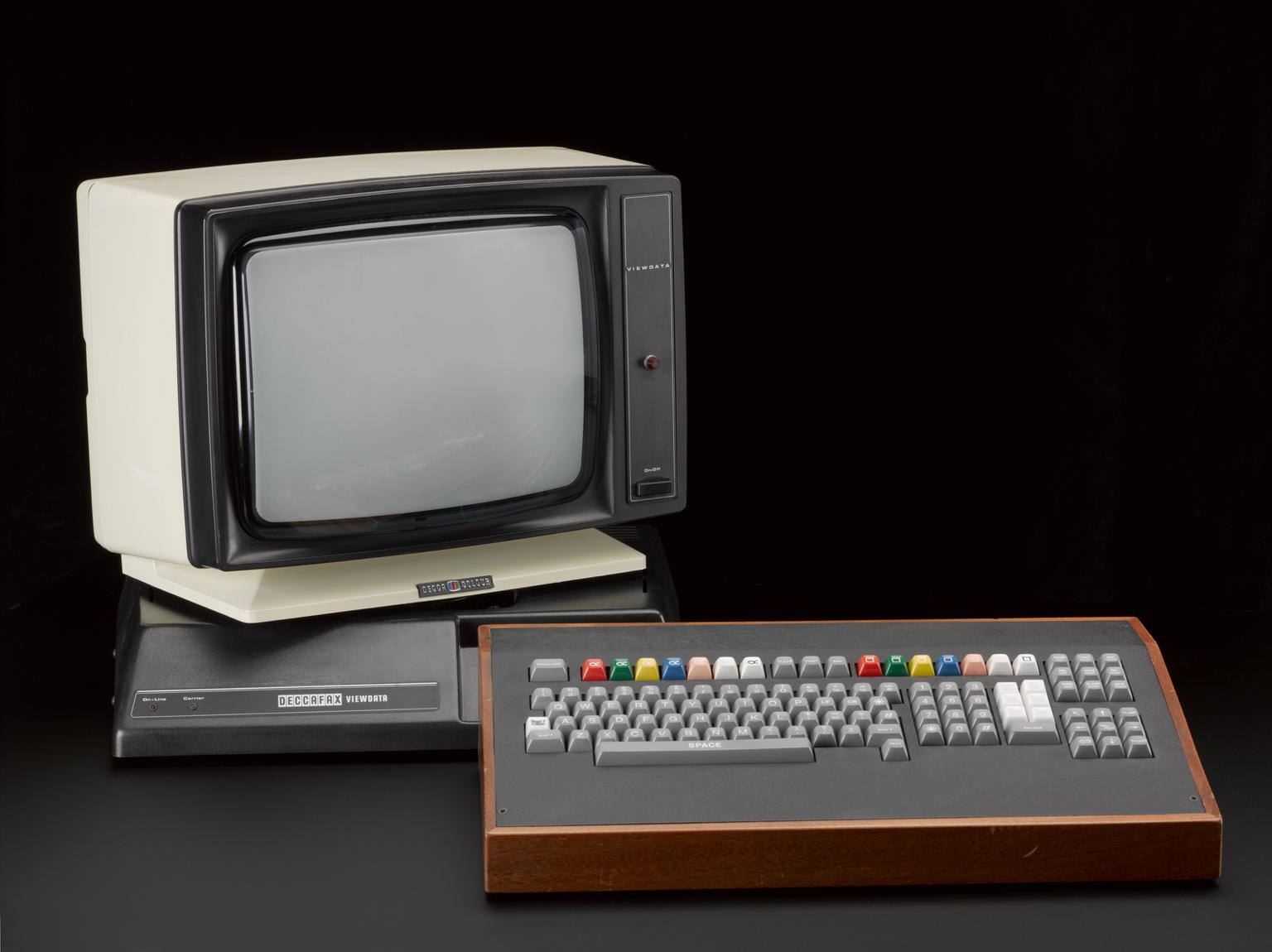
Not the Spectrum rig itself — this is a professional
Deccafax viewdata terminal that served the House of Commons, the same kind
of dedicated hardware Prestel was built for. Schifreen reached the exact
same network from a £130 home computer and a modem. (Science Museum
Group, CC BY-SA 4.0)
A national network, squeezed onto 32 columns
Prestel was Britain's viewdata service: dial a phone number, and a central
database sent back pages of blocky "alphamosaic" teletext-style graphics,
40 characters wide by 24 lines, navigated by typing page numbers. By 1986 it
was reachable at local call rates from 98% of UK phones, carrying banking,
travel booking, and news to tens of thousands of terminals — most of
them dedicated viewdata hardware, not general-purpose computers at all.
A Spectrum could get in too, with Prism Microproducts' VTX 5000: a modem
that sat under the machine, drew its power straight from the expansion
connector, and included its own viewdata terminal software on ROM. The
awkward part was the Spectrum's screen, 32 columns to Prestel's 40 —
the VTX 5000 had to compress the display just to fit. It worked well enough
that Micronet 800, a Prestel service aimed squarely at home computer
owners, built an entire community around exactly this setup.
A password nobody should have known
Schifreen's route in started with nothing more sophisticated than shoulder
surfing: at a trade show, he watched a Prestel engineer log in and
remembered what he saw — a test account, ID 2222222222, password
1234. Dialling around with it, he stumbled onto a BT internal Prestel page
listing phone numbers for the development mainframes. From there, by his
own account, the second half of the break-in came from sheer carelessness
on BT's side: "one day someone left the system manager credentials on
the login page of the dev mainframe." With that, Schifreen had the
keys to essentially the whole system.
Prince Philip's mailbox
He didn't stay quiet about it. Schifreen had already been trying, without
much success, to get BT to take Prestel's security seriously, and demonstrating
just how far in he could get was part of that campaign. It escalated to the
personal Prestel mailbox of Prince Philip — by Schifreen's own
description, mostly full of birthday messages from members of the public
— which he read, and then deleted, explaining afterwards: "I could
read the messages, delete them to cover my tracks before security arrived
for work next morning." He then told Prestel directly what he'd found.
Involving a member of the Royal Family got their attention in a way a
journalist's warnings hadn't: BT called Scotland Yard instead of hiring
him, and Schifreen and a collaborator, Steve Gold, were arrested in March
1985.
Convicted of forgery, for typing a password
There was no computer hacking law to charge them under in 1985, because
none existed yet. Prosecutors reached for the closest available fit, the
Forgery and Counterfeiting Act 1981, arguing that typing someone else's
password counted as "forging" a false instrument. In April 1986 it worked:
Schifreen was convicted on six counts and fined £750.
It didn't survive appeal. In July 1987 the Court of Appeal, led by the Lord
Chief Justice, ruled forgery was the wrong charge entirely, and the House
of Lords rejected the Crown's final appeal in April 1988 on the same
reasoning: a forged "instrument" has to have some lasting physical form, and
a password typed at a keyboard doesn't leave one. If anything created a
false record, it was the computer itself, processing an authentic set of
characters it had no way to know weren't Schifreen's to use — not a
crime forgery law was ever written to cover. Acquitted, on a technicality
that was really a much bigger gap: Britain, in 1988, still had no law that
actually described what Schifreen and Gold had done.
The law that didn't exist yet
Parliament closed that gap directly. The House of Lords ruling is the
case cited, explicitly, as the reason for the Computer Misuse Act 1990
— the UK's first dedicated computer hacking legislation, and still the
law under which hacking is prosecuted in Britain today. Schifreen's own
archive from the case — his password notebook, police interview
transcripts, legal correspondence, the jury bundle — is now held by
The National Museum of Computing, filed as the founding document of British
computer crime law.
None of it needed anything more exotic than a rubber-keyed home computer,
a modem the size of a hardback book, and a password somebody shouldn't have
left lying around. The Spectrum most people remember for Manic Miner and
loading screens spent three years, in this one case, rewriting what
"breaking the law" meant in Britain.
The chip inside your Spectrum also ran Pac-Man, half the arcades of the 1980s, the Sega Genesis's sound, and — through a direct descendant — is still inside graphing calculators being sold today. A plain-English guide to the Z80's 48-year career.
Sinclair stopped making the Spectrum in 1992. Nobody told the Soviet Union. Amateur clones built from smuggled schematics spread across the USSR by the hundreds of thousands — and the newest one was designed in 2025.
No ink, no ribbon, no thermal head. The Sinclair ZX Printer wrote by burning a layer of metal off the page with 50 volts — and it talks to the computer through an I/O port nobody remembers, because nothing else on the machine ever used it.