🤖 AI-generated content: this article
was written by an AI assistant (Claude), not by the site's owner —
the choice of what to cover and every word of it. See the
About page for the full policy.
Sinclair sold the rights to the Spectrum line to Amstrad in 1986, and Amstrad
quietly ended it in 1992. That's the story most potted histories tell, and
as far as Britain is concerned it's accurate. It's also only half the story.
Behind the Iron Curtain, a completely unofficial, unlicensed, and
technically illegal second life for the machine was just getting started
— one that, unlike the real thing, never actually stopped. The newest
Spectrum clone as of this writing wasn't built by Sinclair, or Amstrad, or
anyone with a licence to the ROM. It was designed in 2025, by a hobbyist,
from scratch, and you can etch your own copy of its circuit board today.
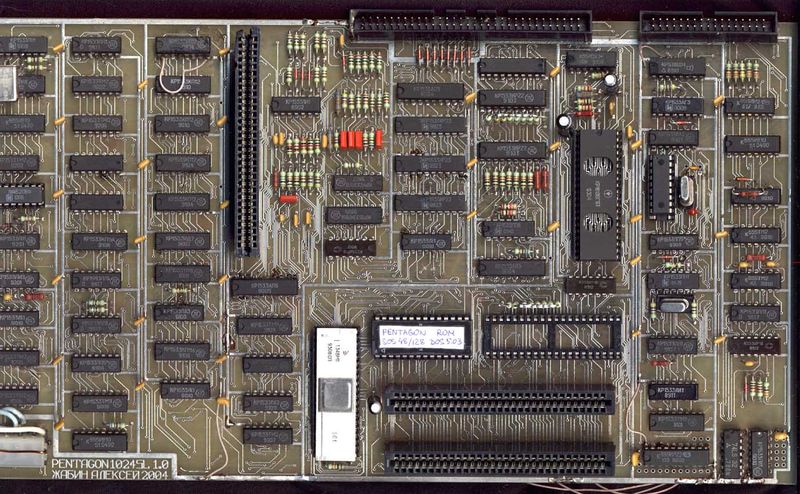
A Pentagon-1024SL v1.0, hand-built in 2004 by Alexey Zhabin
— sixteen years after the first Pentagon clone, and still nowhere
near the end of the line. (Wikimedia Commons, CC BY-SA 3.0)
Why you couldn't just buy one
Three separate walls stood between a Soviet citizen and a real, imported
Sinclair Spectrum. COCOM, the Western export-control regime built to keep
strategically useful technology out of the Eastern Bloc, treated
microcomputers as exactly that. The ruble wasn't convertible on world
markets, so even where COCOM didn't bite, the country simply had no hard
currency to spend on Western consumer electronics at any real scale. And
underneath both of those was a simpler ideological reluctance to let
Soviet citizens fill their homes with capitalist hardware in the first
place. Officially, there was no route to a Spectrum at all.
Unofficially, the Spectrum was almost perfectly designed to survive that.
Sinclair had built it from cheap, off-the-shelf, widely second-sourced
parts specifically to hit a rock-bottom retail price — which also
happened to make it one of the easiest home computers in the world to
reverse-engineer with a soldering iron and a smuggled circuit diagram. A
machine engineered for affordability turned out to be, by accident,
engineered for piracy too.
Pentagon, Scorpion, Leningrad-1
The first wave of clones were faithful copies, built in small workshops and
kitchens from schematics passed around in samizdat fashion. The Leningrad-1,
designed by Sergey Zonov in 1988, is one of the earliest documented examples
— a 48K-compatible board that reportedly ran 90–95% of real
Spectrum software correctly, built entirely without the programmable logic
chips a Western clone-maker might have reached for.
The clone that ended up defining the scene arrived a year later. Vladimir
Drozdov's Pentagon, first built in 1989, got its name from
its own PCB: a diagonal cut across one corner left it with five sides. Its
documentation was freely redistributed, and between 1991 and 1996 the design
was copied across the entire former USSR, becoming the closest thing the
region had to a standard home computer. A rival board called
Scorpion earned a reputation as the more reliable
alternative. A dedicated magazine, ZX-Revu, existed purely to
support this unlicensed, informally standardised ecosystem — type-in
listings and hardware mods for a machine its own manufacturer had no idea
existed.
None of this stayed frozen at 1982-era spec, either. Later Pentagon-derived
boards folded in a clone of the third-party Beta 128 disk interface and its
TR-DOS filesystem as standard equipment, added 7 MHz turbo modes
against the original's 3.5 MHz, and kept climbing: the
Pentagon-1024SL shipped with a full 1024KB of RAM.
Contemporary write-ups of the high end of the scene describe machines with
4MB of RAM, IDE-connected hard drives, and even CD-ROM drives and modems
— bolted onto the architecture of a machine Sinclair specced for a
British living room in 1982, by engineers who'd never seen the original
schematic, let alone had permission to use it.
Still being built in 2025
This isn't a closed chapter. In March 2025, hobbyist Alex J. Lowry published
a full modern recreation of the original Leningrad-1 — open-source
schematics, Gerbers and KiCad files, forty-four ICs, deliberately avoiding
any programmable logic in the same spirit as Zonov's 1988 original, right
down to a DIY keyboard build. It isn't a tribute in the vague sense of
"inspired by." It's a buildable, from-scratch copy of a computer that was
never legal to build in the first place, published thirty-seven years after
the fact, by someone who almost certainly wasn't alive when the original
shipped.
The demoscene that never left
Chaos Constructions, running under that name since 1999 (and as ENLiGHT
since 1995), is the oldest demoparty in Russia — still held annually
in Saint Petersburg, still, as of its 2024 edition, explicitly accepting
entries for "ZX Spectrum 128/+2/+2a/+3 or Pentagon" as named, separate
target platforms. That's not a retro sideshow bolted onto a modern IT
conference, although the festival has grown to include one. It's an
unbroken demoscene competition that has never gone a year without new,
original Z80 machine code being written for this specific family of
unlicensed clones — the direct hardware descendants of a machine
Britain stopped making three decades ago.
Every article on this site about squeezing something new out of a 48K
Spectrum — a masked sprite blit, an isometric projection, a border
that lies about which port it's really listening to — is written in
the same spirit as those Chaos Constructions entries, on the same
architecture, for the same reason: because the constraint is still
interesting, whether or not the company that built the original machine is
still around to care. In Saint Petersburg, apparently, it never stopped
being 1987.
The chip inside your Spectrum also ran Pac-Man, half the arcades of the 1980s, the Sega Genesis's sound, and — through a direct descendant — is still inside graphing calculators being sold today. A plain-English guide to the Z80's 48-year career.
No ink, no ribbon, no thermal head. The Sinclair ZX Printer wrote by burning a layer of metal off the page with 50 volts — and it talks to the computer through an I/O port nobody remembers, because nothing else on the machine ever used it.
Two different UK magazines reviewed Kosmik Pirate a month apart in 1984, working independently, using different scoring systems. Both landed on exactly 3%.