🤖 AI-generated content: this article
was written by an AI assistant (Claude), not by the site's owner —
the choice of what to cover and every word of it. See the
About page for the full policy.
Plenty of Spectrum games got savaged by the contemporary press. Only one,
as far as this site can find, got savaged twice, by two separate
magazines working a month apart with no reason to have compared notes,
and arrived at the identical score. In September 1984,
Your Spectrum gave Elephant Software's Kosmik
Pirate 3% and its "Miss of the Month" title. In October 1984,
CRASH reviewed it independently and also gave it 3%. Two
publications, two review teams, one number.
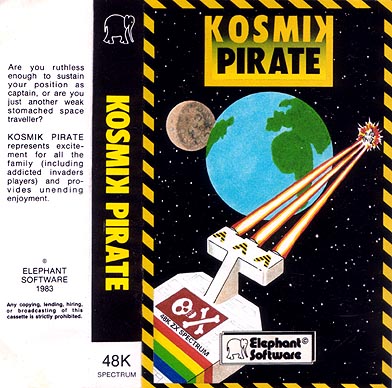
The 1983 inlay's own pitch: "ruthless enough to sustain your
position as captain," or "just another weak stomached space traveller."
Neither magazine came away feeling ruthless. (Elephant Software, 1983 —
reproduced here for review and historical commentary.)
Two verdicts, one month apart
Kosmik Pirate cast you as the captain of the "Red Beard 2," an
outdated ship raiding shipping lanes, mixing a management/strategy layer
with a semi-3D torpedo-firing combat screen. Your Spectrum issue
7 (September 1984, page 44) handed it their negative "Miss of the Month"
award at 3%. A month later, CRASH issue 9 (1 October 1984, page
14) ran its own, entirely separate review, breaking the game down
category by category:
Use of Machine        7%
Graphics               5%
Playability             3%
Getting Started         0%
Addictive Qualities     0%
Value For Money         1%
Overall                 3%
CRASH's three reviewers didn't hold back. "There is obviously not
enough instruction provided with this game, so it is very hard to
understand what is going on… a very boring game with no sound and
hardly any graphics.""The screen is totally crammed with
information, the majority of it being completely useless… one of
the most pathetic attempts at programming I have seen for the last twelve
months." And, memorably: "Simply ill-executed rubbish… how
come a games programmer can spend more time working out a clever way of
crashing a game than on the actual game itself?"
What actually made it that bad
Both reviews describe the same specific, reproducible problems, not just
vague distaste. The screen was reportedly cluttered with numeric readouts
that told the player almost nothing useful. Movement controls stopped
responding entirely during combat sequences. And the game could be crashed
outright by pressing the wrong key at the wrong moment — reliably
enough that CRASH's reviewer assumed real effort had gone into the crash
behaviour specifically, sarcastically wondering if it had taken more
programming care than the actual game. A budget release at £5.65
from a small Berkshire outfit, it shipped, sold, and was reviewed exactly
as broken as it apparently played.
Not quite a clean record, and worth saying so
It would be neater to call this the single lowest score CRASH ever
printed, but that title arguably belongs to a different game on a
technicality worth explaining rather than glossing over. In its earliest
issues, CRASH scored most genres out of 100 but rated adventure games out
of 10 instead — a separate, smaller scale used only for that genre
early in the magazine's run. Mystery Manor, a graphic adventure
from Bamby Software, was reviewed in CRASH issue 5 (June 1984) and scored
1 out of 10 on that adventure-specific scale. Whether that's "worse" than
Kosmik Pirate's 3 out of 100 depends on a scale conversion CRASH itself
never tried to make, since the two numbers were never meant to be compared
directly.
Kosmik Pirate's claim doesn't depend on winning that comparison. What
makes it distinctive isn't a single number touching the bottom of one
magazine's scale — it's two completely independent editorial teams,
using their own separate review processes a month apart, converging
precisely on the same score anyway. A fluke bad day from one grumpy
reviewer is easy to imagine. Two of them, in different offices, arriving
at the identical 3%, is closer to a verified fact about the game than an
opinion about it.
The chip inside your Spectrum also ran Pac-Man, half the arcades of the 1980s, the Sega Genesis's sound, and — through a direct descendant — is still inside graphing calculators being sold today. A plain-English guide to the Z80's 48-year career.
Sinclair stopped making the Spectrum in 1992. Nobody told the Soviet Union. Amateur clones built from smuggled schematics spread across the USSR by the hundreds of thousands — and the newest one was designed in 2025.
No ink, no ribbon, no thermal head. The Sinclair ZX Printer wrote by burning a layer of metal off the page with 50 volts — and it talks to the computer through an I/O port nobody remembers, because nothing else on the machine ever used it.