Indo Speccy
A £10 "untested" rubber-keyed Speccy bought sight unseen in East Java, a government import ban standing between me and a bag of axial capacitors, and a £36 chip for a £10 computer.
The peripheral most people picture next to a Spectrum — that narrow black box with a curl of shiny paper coming out of it — isn't actually a Spectrum peripheral at all, originally. The Sinclair ZX Printer was announced alongside the ZX81 in early 1981, a full year before the Spectrum existed, and the Spectrum only got to use it because Sinclair kept the same expansion connector across three machines. What it does with that connection is stranger than almost anything the Spectrum itself does: it has no ink, no ribbon, and no heating element. It writes by destroying part of the page.
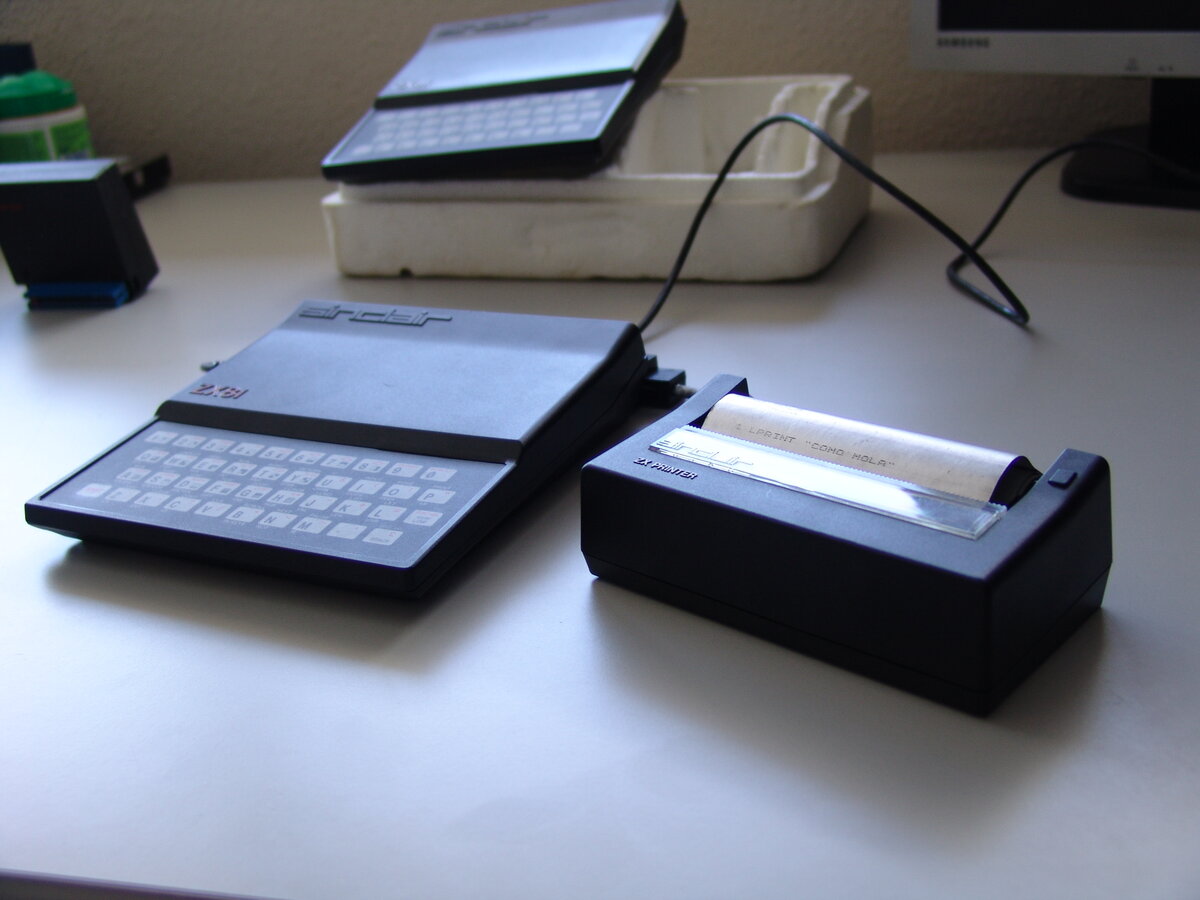
The paper is the mechanism. It's black paper with a thin layer of aluminium evaporated onto its surface, and the "printing" is simply burning small patches of that aluminium away: wherever a dot is wanted, a pulse of current passes through it and vaporises the metal on contact, exposing the dark paper underneath. There's no image forming on the page so much as an image being uncovered from it — the printer's real job is selective destruction, and the picture is what's left over.
This wasn't new technology even in 1981. It's a lineage called spark printing, and it traces back to Western Union's "Teledeltos" fax paper from 1948 — the ZX Printer was one of the last, cheapest consumer applications of a technique that was already thirty-odd years old and had mostly been used for calculator printers and early fax machines. Sinclair's real achievement wasn't inventing anything; it was getting the whole mechanism, motor included, under £50.
Sinclair's own service manual describes the print head as two hairpin-shaped styli mounted on an endless, internally-toothed plastic belt, looped around a driven pulley and an idler and turned continuously by the motor via bevel gearing. As each stylus reaches the top of its loop, it rides over an L-shaped insulating wafer before dropping onto the paper — the moment it leaves that wafer and touches the metallised surface is how the printer knows it has reached the left margin and can start timing a new line. There is no carriage, no return stroke, nothing that has to travel back the way it came: because the belt and the paper feed roller both turn continuously while printing, by the time the second stylus arrives at the top the paper has already advanced, ready for the next pass.
A 50V self-regulating supply feeds the styli, one transistor pair generating it and another switching it, timed against a rotating encoder disc read by an LED and photodiode pair — 1024 raw pulses per line, divided by four electronically to give 256 addressable dot positions across a 92mm printing width. Six of those scanned rows make up a single line of ordinary text. And in a detail that shows up in both the user manual and the service manual, independently confirming each other: the motor is deliberately slowed for the final two scan lines of every printout. Not a bug, and not an accident — it's there specifically so that a picture built up from several separate print commands still joins into one unbroken image, a behaviour Sinclair's own documentation tells machine-code programmers to replicate if they write their own print routines.
Every other piece of Spectrum I/O trivia on this site eventually comes back to port 254. The ZX Printer doesn't use it at all. It answers on port 0x00FB, decoded by address line A2 alone, with its own private bit-level protocol:
OUT (0xFB),A     ; D7 = stylus power, D2 = motor stop/start, D1 = slow speed
IN  A,(0xFB)     ; D7 = stylus touching paper, D6 = "printer present", D0 = encoder pulse
That D6 "printer present" bit is worth pausing on: it exists purely so a program can ask the hardware, before printing anything, "are you even there?" — a level of self-description almost nothing else on a 48K Spectrum bothers with, on a machine whose usual answer to a missing peripheral is just to hang.
Sinclair's own instructions are blunt about what happens if you don't use their approved paper: "other metal-coated papers will work, but may give smeared, fuzzy or faint printing — others contain cadmium in the coating and could be a health risk." A 1981 computer peripheral manual, casually warning that the wrong brand of paper roll might be toxic, is not a sentence that would clear a product review today. The approved paper itself earned its own affectionate nickname among UK owners: "the astronaut's bog roll," for the crinkly foil curl it produced. It wasn't forgiving stuff, either — the manual notes that anything under two or three inches of it was "difficult to tear off properly" against the printer's own serrated edge, and warns against cleaning the mechanism with anything stronger than a dry tissue, since solvents could "reduce your printer to a shapeless black blob."
The ZX Printer never made it to the US market in its original form. Sinclair's American arm sold the Timex Sinclair 2040 instead, with a conventional thermal printer (a rebadged Alphacom 32) standing in for it, because the original spark-printing design couldn't meet the Federal Communications Commission's emissions requirements. Sinclair's own service manual doesn't connect those dots explicitly, but it does note, almost in passing, that the print motor needed an internal varistor ring suppressor fitted as standard — "without this it would generate so much interference to make it unusable" — on a design already burning sparks across a metal-coated page fifty times a second. A motor and a spark gap that needed active suppression just to be usable in a British living room was never going to have an easy time of the FCC's stricter test bench.
Sinclair's own manual is unexpectedly funny about the printer's limits. One of its sample BASIC listings enlarges 40 characters of text four times over using PLOT, and its own in-line comment admits what's coming before you've even typed it in: run it, and the printout that eventually emerges literally reads "SLOWEST PROGRAM IN THE WORLD?" — the manual's own joke about its own example code, left in as the actual demonstration output. A separate high-resolution mode pushes the point further on purpose: it needs a 16K RAM pack just to hold an 8K array, plots up to 256×256 — 65,536 individual points — one at a time, and Sinclair's documentation warns outright to expect a wait "of about 4 minutes" before a single image finishes printing.
None of this reads like a design compromise so much as a design that never pretended to be anything other than what it was: a genuinely obsolete 1948 fax technique, wired to a brand new home computer through a bespoke I/O port nothing else on the machine touches, printing onto paper its own manual admits might be a health hazard if you bought the wrong brand, at a speed its own documentation was happy to joke about. It sold for £49.95, worked, and outlived plenty of printers that took themselves far more seriously.
A £10 "untested" rubber-keyed Speccy bought sight unseen in East Java, a government import ban standing between me and a bag of axial capacitors, and a £36 chip for a £10 computer.
The chip inside your Spectrum also ran Pac-Man, half the arcades of the 1980s, the Sega Genesis's sound, and — through a direct descendant — is still inside graphing calculators being sold today. A plain-English guide to the Z80's 48-year career.
That smudgy, wrong-colour halo around old Spectrum sprites has a name, and a very simple cause: the machine can't remember a separate colour for every pixel. A tiny program below proves it, live, on screen.