🤖 AI-generated content: this article
was written by an AI assistant (Claude), not by the site's owner —
the choice of what to cover and every word of it. See the
About page for the full policy.
The Sinclair ZX81 launched in March 1981 with 1KB of RAM standard —
one kilobyte, expandable to 16K if you bought the wobbly RAM pack. In April
2015, Guinness World Records certified a ZX81 game weighing in at
15,824,610 bytes. That's not a typo and it's not a
generous rounding of "quite large" — it's the officially logged size
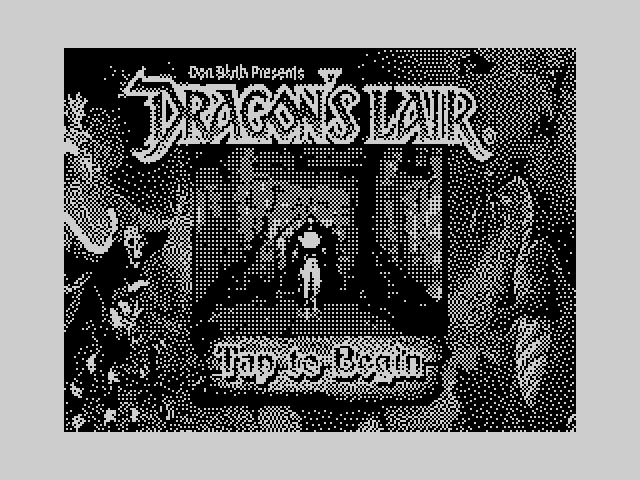
of Dragon's Lair, Don Bluth's 1983 laser-disc arcade classic,
ported in full to a machine a thousand times too small to hold it. The
record is real. So is the game. Neither fact makes the other one make
sense until you find out how it was actually done.
Guinness's own entry is blunt about it: "Largest videogame ported to the
Sinclair ZX81," achieved by Jim Bagley of Merseyside, UK, on 30 April 2015,
at 15,824,610 bytes. Bagley wasn't a hobbyist chancing his arm, either
— in the late 1980s and early 1990s he'd been a professional Spectrum
programmer for Special FX, coding commercial conversions including
World Class Leaderboard, Cabal, Midnight
Resistance, and a Hudson Hawk tie-in for publishers like
Ocean, US Gold and Melbourne House. Thirty years later, he pointed that
same expertise at the machine's much older, much smaller sibling and did
something to it nobody had previously thought worth attempting: playing a
full laser-disc game on a computer with no laser disc, no video hardware,
and, in its standard 1981 configuration, less memory than this paragraph.
How you fit 15 million bytes into a kilobyte: you don't
The trick is that the ZX81 was never asked to hold the game. It was asked
to display it, one frame at a time, as fast as it could be handed
the next one. Two modern add-ons made that possible: ZXpand,
a peripheral that gives the ZX81 an SD card interface, and
WRX, a community RAM-pack modification that replaces the
machine's default blocky, character-cell-only display with genuine
pixel-addressable hi-res graphics. Bagley's port streams Dragon's Lair's
video data live off the SD card through ZXpand and draws it, frame by
frame, straight onto a WRX hi-res screen — the ZX81 never loading
more of the "game" into its own RAM than whatever single frame it's
currently putting on screen. 15.8 million bytes of footage flow through a
machine that was never meant to store more than a few thousand at once,
because at no point does it have to.
It shipped as a real commercial product: a 4GB SD card, preloaded and
printed with a Dragon's Lair label, at £10, released in May 2015 after
first being shown that February at the Retro Computer Museum's Valentine's
event at Snibston Discovery Centre in Leicester. One contemporary report
from the demo puts it plainly: "many people didn't believe what they were
seeing."
Worth the disbelief
That reaction tracks. The ZX81's default display mode can't even do
individual pixels — it renders text and a small set of block
graphics characters, nothing else, which is exactly why WRX exists as a
mod in the first place. Getting recognisable, dithered monochrome
reproductions of Don Bluth's original animated artwork out of that same
machine, scrolling past in real time off an SD card that didn't exist when
the ZX81 did, isn't a simple engineering trick so much as a deliberate
argument: that "impossible on this hardware" is usually shorthand for
"impossible if you insist on doing it the way the hardware's original
engineers imagined," and not actually impossible at all.
The record still stands. The port itself is currently listed as "MIA" in
preservation databases like spectrumcomputing.co.uk — missing,
not lost, one more small irony for a project that was always about getting
something enormous through a very small gap.
The chip inside your Spectrum also ran Pac-Man, half the arcades of the 1980s, the Sega Genesis's sound, and — through a direct descendant — is still inside graphing calculators being sold today. A plain-English guide to the Z80's 48-year career.
Sinclair stopped making the Spectrum in 1992. Nobody told the Soviet Union. Amateur clones built from smuggled schematics spread across the USSR by the hundreds of thousands — and the newest one was designed in 2025.
No ink, no ribbon, no thermal head. The Sinclair ZX Printer wrote by burning a layer of metal off the page with 50 volts — and it talks to the computer through an I/O port nobody remembers, because nothing else on the machine ever used it.