Indo Speccy
A £10 "untested" rubber-keyed Speccy bought sight unseen in East Java, a government import ban standing between me and a bag of axial capacitors, and a £36 chip for a £10 computer.
Sinclair Research started work on the machine that became the ZX Spectrum in September 1981, and internally it was conceived as something close to "a ZX81 with colour" — a description that keeps the real story in view: this was never a clean-sheet design, it was the fastest, cheapest route from a black-and-white machine to a colour one. Industrial designer Rick Dickinson, fresh off a Design Council award for the ZX81's case, was handed the job of making the new machine look "sleeker and more marketable" while somehow fitting all 192 of Sinclair BASIC's keywords onto 40 physical keys. Asked about it decades later, in 2007, he didn't dress it up: "everything was cost driven." The machine launched on 23 April 1982, unveiled to the press at the Churchill Hotel in Marylebone.
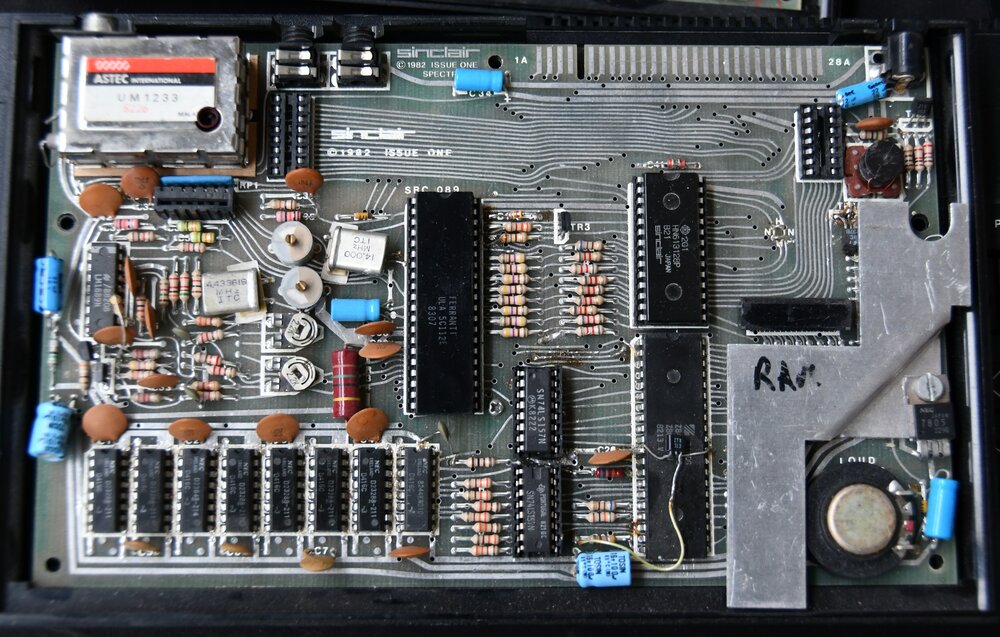
FERRANTI ULA 5C1 just left of centre is
doing the job this whole article is about. (Fernando Sáenz Perez,
Wikimedia Commons, public domain)Sinclair never spelled out the reasoning in a press release, but the documented facts point the same direction from every angle. The company's previous machine, the 1980 ZX80, already ran a Z80-family chip (typically a NEC μPD780C-1, a licensed Z80 equivalent, at 3.25–3.55MHz) — so the BASIC ROM and the toolchain built around it were already Z80 code by the time the Spectrum was on the drawing board, and there was no reason to throw that away. By 1982 the Z80 itself was multiply second-sourced — Mostek's MK3880, SGS-Thomson's Z8400, Sharp's LH0080, NEC's own μPD780C — which mattered commercially in exactly the way it sounds: competition between fabs kept the unit price down and supply secure, which was "considered essential" for exactly this kind of high-volume consumer design. It also only needed a single 5-volt supply, against the Intel 8080's three separate rails, simplifying the power circuitry on top of everything else. None of that required loyalty to Zilog specifically — it required a chip that was cheap, plentiful, and already proven in-house, and by 1982 the Z80A fit all three.
The single biggest cost-cutting decision in the whole machine wasn't the processor, though. It was the ULA — an Uncommitted Logic Array, manufactured by Ferranti to a design led by Sinclair engineer Richard Altwasser, that folded video generation, tape and audio I/O, keyboard scanning, memory contention and interrupt timing onto one custom chip. That's the job a less cost-obsessed design would have spread across dozens of separate off-the-shelf logic chips, each one adding to the bill of materials and the board space. One chip instead of dozens is most of how Sinclair kept the case as small, and the price as low, as it did.
It's also the reason every Z80 program on this site has to think about colour the way it does. Altwasser's scheme for cramming colour into a cost-constrained machine used eight bits per 8×8 pixel cell — three bits each for ink and paper colour, one for brightness, one for flash — which delivered colour on a budget but capped every single cell at two colours, no exceptions. That's attribute clash, the constraint behind more than one bug class documented on this site's own attribute-memory deep dive and sprite-compositing write-ups: it isn't a software bug at all, it's a 1982 silicon decision that's still binding on anyone writing Z80 code for this machine in 2026. The same chip ran hot enough that Sinclair trialled an alternative ULA design from AMI (the "SAGA" chip) in at least one limited production run; surviving units confirm it ran measurably cooler than the standard Ferranti part, which is about as close to an admission of a heat problem as a hardware swap gets.
The ULA wasn't the only place the budget showed. The keyboard replaced a conventional switch under every key with a single moulded rubber sheet over a membrane — "four or five moving parts," Sinclair's own figures claimed, in place of the hundreds a normal keyboard needed. Contemporary reviewers were less diplomatic, describing the feel as that of "dead flesh." There was no dedicated monitor output either: the Spectrum drove an RF modulator so it could plug straight into whatever television was already in the room, and it saved money on storage the same way, using cassette tape instead of a floppy disk drive. None of the first three hardware revisions (16K, 48K, or the later Spectrum+) shipped with a sound chip at all — music and effects came entirely from a single piezo beeper, driven directly by the ULA. And the price itself tells the same story in two numbers: £125 for 16K and £175 for 48K at launch in April 1982, cut again to £99 and £129 within a year, as Sinclair kept squeezing the same design for a lower number.
The Spectrum name outlived the "£99 rubber-keyed micro" a long way past
1982. The Spectrum+ arrived on 15 October 1984 at
£179 (cut to £129 by early 1985), keeping the original
motherboard but swapping the rubber keys for a QL-style plastic keyboard
with a reset button, assembled by AB Electronics in South Wales and
Samsung in South Korea. The Spectrum 128 went further and
arrived somewhere else entirely first: developed with the Spanish
distributor Investrónica, it launched at Spain's SIMO '85 trade show
in September 1985 (44,250 pesetas) before reaching Britain in January
1986 at £179 — the first Spectrum with proper multi-channel
sound (a three-channel AY-3-8912 chip), an RS-232 serial port paired with
a new BASIC PLAY command, and an external heatsink prominent
enough to earn the machine the nickname "the Toast Rack."
Sinclair sold its entire computer business, Spectrum included, to Amstrad on 7 April 1986 for £5 million, and every model after that carries Amstrad's fingerprints. The +2 arrived in a grey case with a proper spring keyboard — the rubber era was over — a built-in cassette deck, and a boot message that read plainly "© 1986 Amstrad," at £149. The +3, in 1987, replaced the tape deck with a built-in 3-inch floppy drive (£249, later £199) and switched to a DIN power connector incompatible with every earlier model's supply. The +2A, from late 1988, reused the +3's circuit board and black case but kept the cassette deck instead of the floppy. Amstrad discontinued the +3 in December 1990, and wound down every remaining Spectrum model in 1992 — ten years, and five distinct hardware redesigns, after a machine that started life as "the ZX81 with colour."
A £10 "untested" rubber-keyed Speccy bought sight unseen in East Java, a government import ban standing between me and a bag of axial capacitors, and a £36 chip for a £10 computer.
The chip inside your Spectrum also ran Pac-Man, half the arcades of the 1980s, the Sega Genesis's sound, and — through a direct descendant — is still inside graphing calculators being sold today. A plain-English guide to the Z80's 48-year career.
That smudgy, wrong-colour halo around old Spectrum sprites has a name, and a very simple cause: the machine can't remember a separate colour for every pixel. A tiny program below proves it, live, on screen.